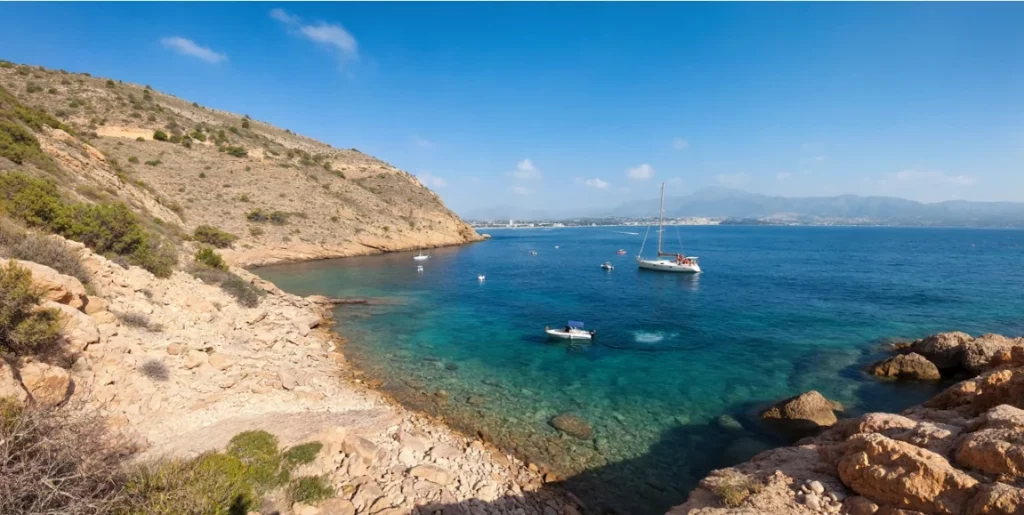
Cala de la Mina is the wildest and most secluded of the three coves of El Albir. It hides at the foot of the cliffs of the Serra Gelada: no sand, no beach bars and almost no people, with water so clear that it has earned a reputation as one of the best spots for snorkeling in the whole area. And its name is no coincidence. There were once ochre mines here, and their traces still remain scattered across the ravine.
As an Albir local, it’s one of those coves you only show to someone you truly want to get to know the mountains from the inside. Let me tell you what you’ll find, how to get there without any scares, the real history of its mines and how to make the most of it.
Table of Contents
ToggleWhat Is Cala de la Mina and Why It’s Worth a Visit
It’s a rocky, unspoiled cove inside the Serra Gelada Natural Park, between the bays of Altea and Benidorm. No fine sand here: there’s rock, pebbles and stone platforms reaching into the sea. There’s no lifeguard, no showers and no bins. Whatever you bring in, you take back out with you.
In return, it offers four things that almost no other cove in the area brings together at once:
- Crystal-clear water in shades ranging from deep blue to emerald, with very good visibility when the sea is calm.
- Real peace and quiet: the on-foot access puts off the towel-and-parasol crowd, so it’s rarely crowded.
- Protected seabeds, with Posidonia seagrass meadows and plenty of life for snorkeling.
- A unique historical value, that of its old ochre mines, which you won’t find in the neighboring coves.
In short, it’s the choice for anyone who values nature and silence over comforts.
How to Get There and Where It Is
The cove is at the northern tip of the Serra Gelada, in the municipality of l’Alfàs del Pi, very close to the Albir Lighthouse. There are two ways to get there: on foot or by sea.
On Foot, Along the Lighthouse Path
It’s the most common way in and also the most beautiful.
- Starting point: the car park at the park’s Interpretation Centre, at the end of the Camí del Far. Parking is free, but in high season and on weekends it fills up early; go early.
- Main route: a paved track of about 2.5 km (around 5 km round trip) up to the lighthouse, with a gentle slope, viewpoints and information panels. This stretch is easy and family-friendly. If you fancy taking it slowly, you’ll find all the details in the walk up to the Albir Lighthouse.
- Turn-off to the cove: shortly before the lighthouse, a dirt and loose-stone path branches off to the left and drops steeply down towards the mines and the cove. It isn’t signposted like the other paths and is not suitable for pushchairs or people with reduced mobility.
Rough estimate: between 20 and 30 minutes from the car park to the shore, depending on your pace. The way back, uphill, calls for a bit of fitness. Avoid going down after rain or when there’s swell: the rocks get slippery.
By Sea, by Kayak or Paddleboard
It’s the most convenient option and, in summer, the one many people prefer to dodge the heat of the walk.
- You set off from Albir Beach, hugging the coast (about 2 km), or from the Bay of Altea.
- Anchor sensibly: use the eco-friendly buoys where they exist and don’t drop anchor on the Posidonia seagrass.
- Always check the wind and swell forecast. If there’s an easterly wind or the sea is choppy, it’s better to leave it for another day.
Parking and Public Transport
Besides the free car park at the interpretation centre, you can get there by TRAM (with stops in L’Alfàs, Altea or Benidorm) and connect with a bus or on foot to El Albir. From Avenida del Albir you can walk to the start of the lighthouse route.
The History: The Ochre Mines of Albir
Here’s what makes this cove special, and what hardly any article gets right.
Ochre is a mix of clay and iron oxides that has been used since ancient times as a pigment: for paints, for dyeing fabrics and, in this area, even for painting the skirting of house façades. In the ravine that runs down to this cove there was once a works to extract it, and that’s where the name comes from.
The mine was known as “Virgen del Carmen”. According to the municipal records of l’Alfàs del Pi and the Generalitat Valenciana itself, it was a small-scale operation that ran from the mid-19th century until the early 20th.
In the late 19th century it was run by a family from l’Alfàs, the Soler-Devesa family, still known in the village by the nickname “de la mina” (of the mine). The foreman was Miguel Soler Devesa, who emigrated to Algeria in 1888 and left his wife, Esperanza, in charge of the workers. The legal holder of the concessions was the Alicante merchant Julio Pillet Blanc, whose application was authorised by royal decree in December 1886.
El sistema de trabajo era ingenioso para su época: el mineral se cargaba en vagonetas que descendían por unos raíles sostenidos por pilares a lo largo del barranco, hasta la orilla. Allí se pasaba a barcazas que lo llevaban a un barco fondeado en la bahía.
Today, that history is still on view as a small cluster of industrial archaeology:
- Los restos de la vivienda del capataz y otras dependencias, en ruinas.
- The line of pillars that ran down the ravine holding up the rails.
- The mouths of the tunnels dug into the hillside, recognizable by the reddish tone of the earth.
An important warning: do not enter the galleries or caves. They are not fitted out for visitors and there is a real risk of rockfalls and lack of oxygen. You can take them in from the outside, and even that is impressive enough.
What the cove looks like today: landscape and geology
The Serra Gelada is a coastal massif that rises straight out of the sea as monumental cliffs. Its walls reveal limestone and marl folded and faulted, along with those ochre and reddish tones that betray the presence of iron. Underwater, rocky platforms alternate with submerged boulders and patches of Posidonia seagrass.
The cove itself is small, just a few dozen metres across, facing northeast and somewhat sheltered by the terrain, which helps keep the water clear and calm when the sea is still. Don’t expect any amenities: expect rock, sea and silence.
Wildlife and plants you’ll see
On land, Mediterranean scrub dominates: dwarf fan palm, mastic, rosemary, thyme and Aleppo pine on the hillsides. In spring, the aromatic plants burst into life and draw in the pollinators.
Up in the air, it’s a spot for seabirds and birds of prey: European shag, gulls and, with a bit of luck, peregrine falcon, as well as migratory birds passing through.
And underwater is where snorkelling really shines: sea bream, the odd moray eel, octopus, starfish and the meadows of Posidonia, that underwater forest that oxygenates the water and protects the coast. Further out, at dawn and dusk, it’s not unusual to spot bottlenose dolphins.
What to do at Cala de la Mina
Snorkelling and light diving
This is the big draw. With a flat sea and good visibility, the rocky bottom and the nearby Posidonia turn any dip into a small but really eye-catching underwater outing. Bring a mask, snorkel and water shoes (the bottom is rocky), and a UV-protection shirt if you’re going to spend a while face down. Golden rule: don’t touch or step on the Posidonia, don’t stir up the sediment and don’t feed the fish.
Kayaking and paddle surfing
The coastal route from Playa del Albir is gorgeous, and along the way you can pop into the other coves if the sea is on your side. Bring a mooring line and respect the anchoring buoys.
Photography and wildlife watching
The golden hour, with the ochre of the cliffs set against the blue of the sea, is postcard-perfect. The viewpoints along the path to the lighthouse give you clean framings, and a pair of binoculars will come in handy for the birds and, with luck, the whales and dolphins.
What to bring and park rules
Before you head out, pack the following in your rucksack:
- Water (at least 1.5 litres per person) and something to eat: there’s nothing here.
- Sun protection: hat, sunglasses and sunscreen. There’s very little shade.
- Two types of footwear: trainers for the walk and water shoes for swimming.
- A charged phone; the signal is patchy in some stretches.
- A bag to take out all your rubbish.
And respect the rules of the Serra Gelada Natural Park, which exists precisely so that this stays the way it is:
- Don’t pull up plants or take away rocks or fossils.
- Don’t disturb or feed the wildlife.
- No fires or smoking in the park.
- Dogs on a lead, and clean up after them.
- No camping and no disruptive noise.
- Stick to the authorized paths only and, in the water, respect the Posidonia and the nautical signage.
The best time to go
- Spring and autumn: the best time. Mild weather, flowers in bloom and very few people.
- Summer: great for swimming and snorkelling, but go early to find parking and avoid the heat on the climb up.
- Winter: clean landscapes, crisp light and the mountains almost all to yourself.
At sunset, in any season, is when the cove is at its most beautiful.
Cala de la Mina, del Metge or del Amerador: which one to choose
El Albir tiene tres calas hermanas bajo la sierra, y conviene saber en qué se diferencian antes de decidir. Lo tienes todo comparado en la guía de las tres calas de El Albir, pero en corto:
- Cala de la Mina: the one with the greatest historical interest thanks to its ochre mines, somewhat more sheltered and with very rewarding snorkelling when the sea is flat. Its final descent is the most demanding.
- Cala del Amerador: very small and shallow, perfect for getting started with snorkelling; the access is short though uneven.
- Cala del Metge: the one with maximum isolation and wider views, but with the toughest access routes. For experienced hikers.
Frequently Asked Questions
Are there any services at Cala de la Mina? No. There’s no lifeguard, toilets, showers or beach bar. You have to bring everything you need and take your rubbish with you when you leave.
Is the descent dangerous? The last stretch is steep and made of loose earth. With good footwear and taking your time, it’s manageable for someone who’s fit, but it’s best to avoid it on rainy or rough-sea days.
Can I go with children? The route to the lighthouse, no problem. The descent to the cove only with children who are used to the trail, with suitable footwear and always with one adult in front and another behind.
Is it good for snorkelling? Yes, when the sea is calm. Rocky bottom, clear waters and Posidonia nearby. Don’t forget your water shoes.
Is nudism practised here? Occasionally, especially in the low season. It’s not an official nudist cove, but bathers of all kinds coexist without any problem.
Better to arrive by sea or by land? By sea it’s convenient if you’re good with a kayak or paddleboard and the maritime forecast is favourable. By land you enjoy the viewpoints and the information panels along the path to the lighthouse. In summer, many people prefer the sea.
A perfect plan around the cove
My local’s tip: save Cala de la Mina for a day when the sea is calm, go down slowly and come back up without rushing. And when you’re done, once hunger kicks in after the walk, you’ve got good options to refuel at the restaurants in El Albir.
If you’re planning your visit —or thinking of something more than a day out— in everything El Albir has to offer you’ll find all the other spots, beaches and tips for getting around the area like a local. And if you want to keep exploring other options, check out our guide to the Calas del Albir