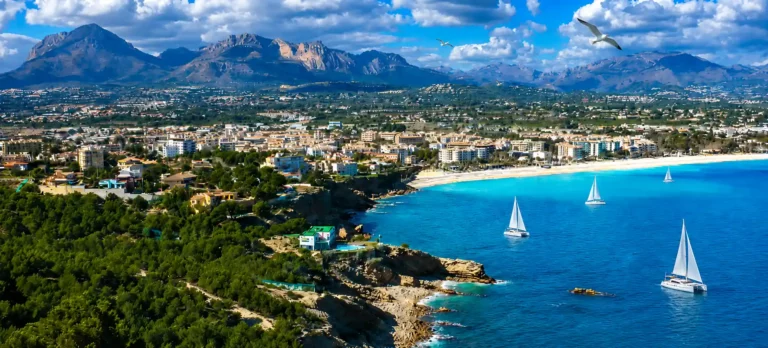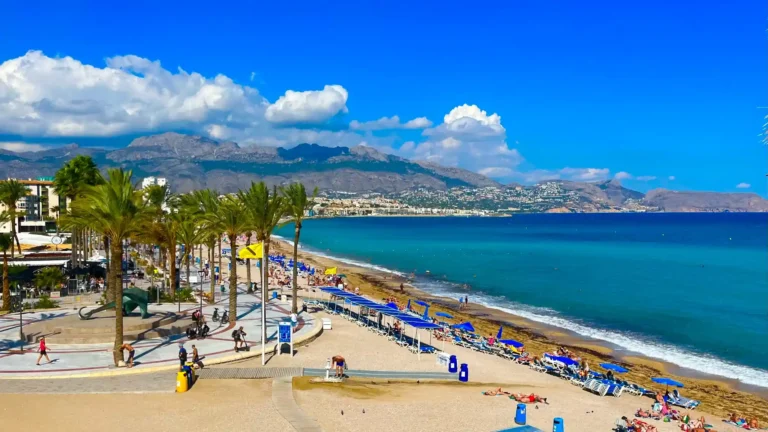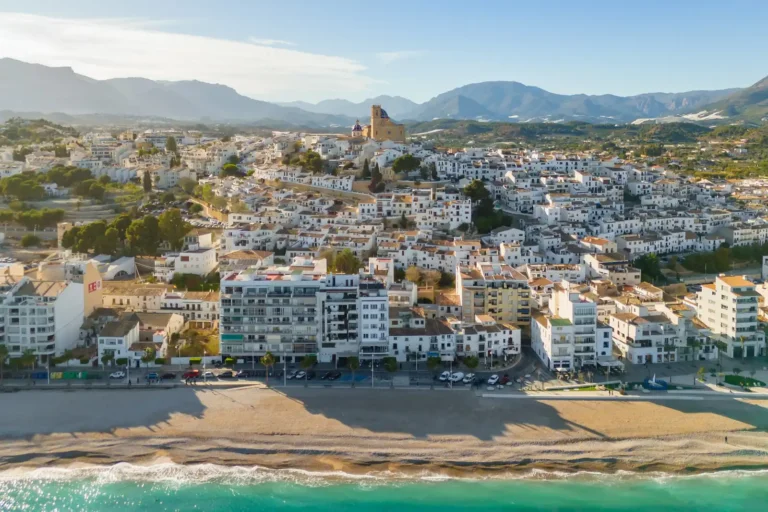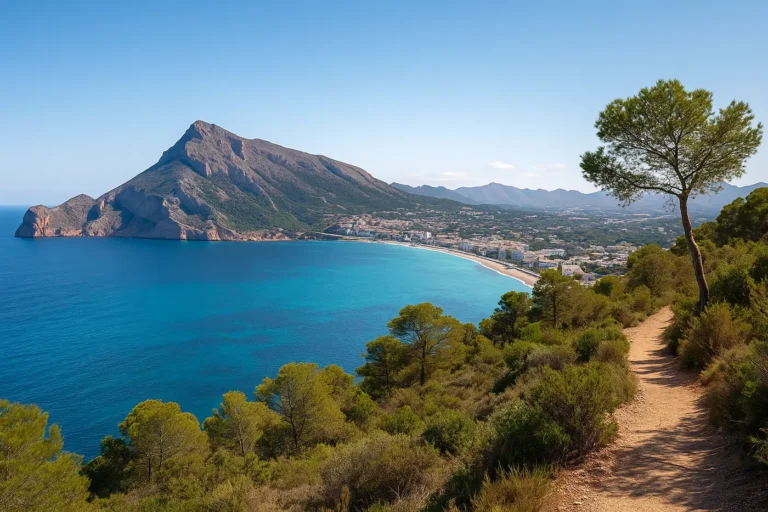
I’ve lived at the foot of the Serra Gelada for almost twenty years, and there are still days when I walk up the Cami del Faro and stop to look at the cliff. Not because I haven’t seen it a thousand times, but precisely because I have.
The Serra Gelada Natural Park (also known as Sierra Helada) is one of the best areas for hiking on the Costa Blanca, between El Albir, Altea and Benidorm. Here you’ll find trails like the Faro del Albir, cliffs over 300 metres high, spectacular viewpoints, and some of the cleanest water in the area for snorkelling.
Table of Contents
ToggleQuick facts
- Location: between El Albir, Altea and Benidorm
- Easiest route: Faro del Albir (5 km, round trip)
- Toughest route: hike up to the Cruz de Benidorm (~8.5 km, one-way, 4-5 h)
- Viewpoints: the circular one (Altea bay + Penyal d’Ifac), the tunnel one, and the Alfonso Yébenes Simón, plus the outcrop next to the lighthouse
- Highest point: Alt del Governador, 438 m (antennas and geodetic marker)
- Best plan: trail + viewpoints + a swim
- Snorkelling and diving: some of the best seabeds on the Alicante coastline; visibility of up to 20 m on calm days
- Parking: Camí del Faro (free, but fills up before 9am in summer)
- Best time: early morning or sunset
- Dogs: allowed on a lead
- Bikes: paved lighthouse road, allowed during regulated hours (until 10am and after 8pm); interior paths are pedestrian-only
- What to bring: water (there are no fountains), comfortable shoes, sun protection, and something warm for the wind
If you’re staying in El Albir, this is probably the best excursion you can do without needing the car.
In this guide, I’ll walk you through what actually matters:
- Which trails are worth doing depending on your level
- Where to park without wasting time
- What to see in the Serra Gelada, step by step
IS THE SERRA GELADA WORTH VISITING?
Yes, but it depends on what you’re after.
✓ It’s well worth it if:
- you love walking with sea views
- you want an easy route like the Faro del Albir
- you’re after nature without leaving El Albir
❌ It’s not for you if:
- you’re after a comfy sandy beach
- you don’t want to walk at all
- you come in August at 2pm (classic mistake)

WHY IS THE SERRA GELADA DIFFERENT?
It’s not just that it’s beautiful. It’s that everything here is rawer:
- Cliffs of 300–400 metres dropping straight into the sea
- Fossil dunes visible in the rock (there’s nothing else like it in Europe)
- A land-and-sea park: what you see above and what lies beneath the water are both protected
- Routes for everyone: from an easy stroll to a demanding ridge
- Real wildlife: falcons, cormorants, dolphins, and seagrass meadows
It’s not a park for “going for a stroll”. It’s a place that genuinely leaves an impression.
STANDOUT ROUTES IN THE SERRA GELADA
If you’re staying in El Albir, the most obvious starting point is the lighthouse route. From there, you can explore the rest of the park depending on how much time you have and how much you feel like walking.
Before we get into the details, here’s a quick comparison to help you choose without the hassle:
Route summary table
| Route | Distance | Time | Difficulty | Elevation gain | Start |
|---|---|---|---|---|---|
| Albir Lighthouse | 5 km (i/v) | 1h 30 – 2h | Low | +120 m | Camí del Faro |
| Cliffs Trail | 8–10 km | 4h – 5h | Moderate / High | +400 m | Ridge Trail |
| Morro de Toix | 6 km | 2h 30 – 3h | Moderate | +250 m | Altea Hills |
WHICH ROUTE SHOULD YOU CHOOSE FOR YOUR LEVEL?
- If it’s your first time in El Albir:
Start with the Faro del Albir. It’s easy, quick, and delivers incredible views without much effort. - If you want wilder views and don’t mind the effort:
The Cliffs Route is the most powerful in the park. It’s not a stroll. - If you’re after something calmer with fewer crowds:
El Morro de Toix is the lesser-known, more relaxed option.
GENERAL MAP OF THE SERRA GELADA
HIKING ROUTES IN THE SERRA GELADA
The Serra Gelada isn’t a park you view from the outside: you experience it on foot. And that’s where it really shines. You’ve got everything from an easy, paved route like the Faro del Albir, to more demanding ridge trails with direct views of the cliff. If you’re staying in El Albir, it’s normal to start with the lighthouse and, if you like it, move on to longer routes another day.
FARO DEL ALBIR ROUTE (5 KM – EASY)
It’s the most popular route in the Serra Gelada, and if you’re staying in El Albir, it’s the one you shouldn’t skip.
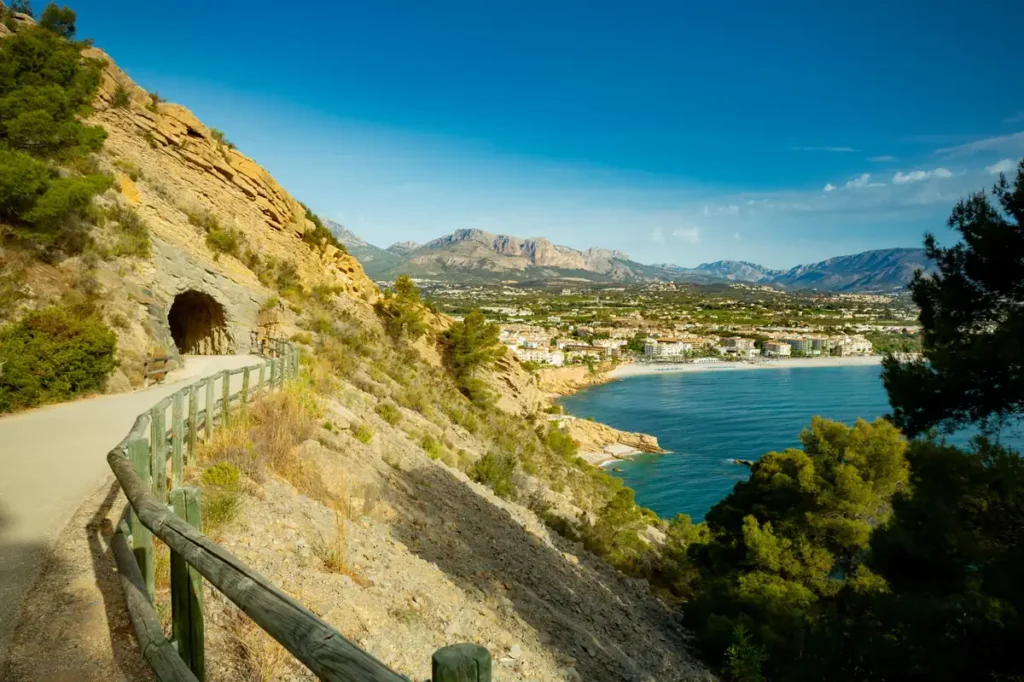
It’s about 5 km round trip, with very little elevation gain and a wide, well-maintained path. You can’t get lost.
Without exaggeration, it’s the most rewarding route in the whole area: easy, quick, and with views that feel like they belong to a much tougher hike.
Along the way you have the Mediterranean in view almost the whole time. Past the tunnel carved into the rock, the landscape changes: the cliff drops away beside you and the sea opens up completely.
On clear days you can see Calpe, the Peñón de Ifach, and even Ibiza on the horizon.
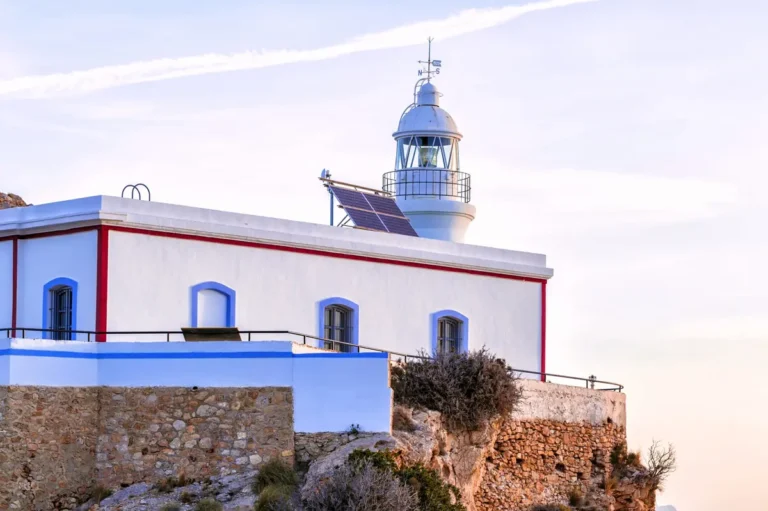
The lighthouse, built in 1863, now serves as an interpretation centre and marks the end of the route, with one of the best views of Altea Bay.
Fact sheet – Faro del Albir
- Distance: 5 km (round trip)
- Duration: 1h30 – 2h
- Elevation gain: +120 m
- Difficulty: low
- Terrain: paved and easy
- Start: Camí del Faro (El Albir)
Real tip: if you’re visiting in summer, head up before 9:00 am or at sunset. At midday the heat is intense and there’s no shade.
CLIFFS ROUTE (MEDIUM-HIGH)
Here we shift up a level.
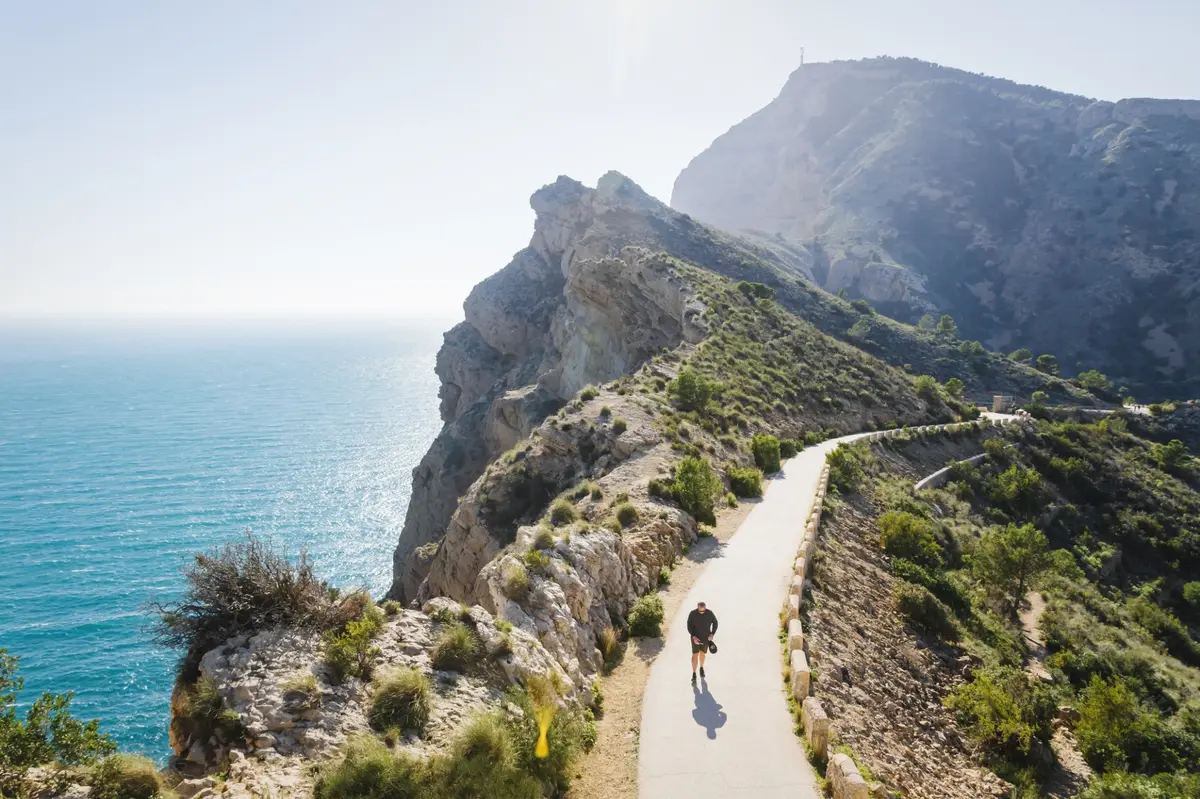
The Cliffs Route follows the ridge of the Serra Gelada and has nothing to do with the Lighthouse route. The terrain is uneven, the paths are narrower, and there are exposed stretches.
This isn’t a tourist route. If you don’t have mountain experience, it’s better not to improvise here.
But if you can do it, it’s the most spectacular one: you walk with open air on one side and the Mediterranean below, with continuous views of Benidorm and its island.
On clear days you’ll see birds of prey flying at your height, and a sense of height you won’t get on any other route in the area.
Fact sheet – Cliffs Route
- Distance: 8–10 km
- Duration: 4–5 hours
- Elevation gain: +400 m
- Difficulty: medium-high
- Terrain: uneven path, exposed sections
- Start: crest viewpoint
Important: there’s no water along the whole route. Bring enough, and avoid days with strong wind.
MORRO DE TOIX ROUTE (QUIET AND LESS WELL-KNOWN)
Morro de Toix is the alternative for anyone who’s already done the Lighthouse route and wants something different without getting onto the ridge.
It’s in the Altea area (Altea Hills) and offers a different perspective: you see the Serra Gelada from outside, with the bay at your feet and far fewer people.
It’s the quietest of the three routes, even in high season.
The terrain is uneven but has no technical sections. Ideal if you want to walk without the crowds.
Fact sheet – Morro de Toix
- Distance: 6 km
- Duration: 2h30 – 3h
- Elevation gain: +250 m
- Difficulty: medium
- Terrain: dirt path, exposed to the sun
- Start: Altea Hills
Tip: avoid the midday hours in summer. The sun is strong here and there’s no shade.
OUTDOOR ACTIVITIES IN THE SERRA GELADA
Beyond hiking, Serra Gelada Natural Park offers a wide range of activities for nature and sea lovers. It is an ideal place both for families and for adventurers looking for different experiences on the Costa Blanca.
Climbing and mountain biking: some rocky faces are ideal for climbing, and the more challenging trails attract cyclists who want to test their strength and endurance.
Birdwatching: The cliffs are a habitat for seabirds and birds of prey. Spring and fall are prime times for seeing migratory species, making the park a popular spot for ornithologists and enthusiasts.
Snorkelling and diving: the crystal-clear waters surrounding Serra Gelada allow you to enjoy colourful fish, rocky seabeds and a wide variety of marine life. It is one of the best snorkelling areas on the Costa Blanca thanks to its water quality and rich natural environment.
Posidonia meadows (protected ecosystem):
Serra Gelada’s waters are home to extensive meadows of Posidonia oceanica, a seagrass essential to the health of the Mediterranean. It acts as a natural nursery for hundreds of species, keeps the water clear, and stabilizes the seabed.
These meadows are strictly protected:
no se puede fondear sobre ellas;
They must not be walked on or removed;
and marked areas must be respected when snorkelling or diving.
Boat trips: allow you to admire the cliffs from the sea and discover hidden caves along the coast. It is a different —and spectacular— way to appreciate the grandeur of Serra Gelada, with routes departing mainly from the port of Benidorm.
GEOLOGY OF THE SERRA GELADA: CLIFFS AND FOSSIL DUNES
What makes the Serra Gelada special isn’t just what you see… it’s how it was formed.
The cliffs drop between 300 and 400 metres straight into the Mediterranean, among the tallest on the entire Spanish coast. But the interesting part is in the rock itself: here you can see fossil dunes embedded in the wall, something practically unique in Europe.
Put simply: you’re walking over what was, millions of years ago, the seabed.
If you look closely in some spots, you’ll spot fossils of corals and molluscs. There aren’t signs everywhere, but they’re there.
FLORA OF THE SERRA GELADA: PLANTS THAT SURVIVE ANYTHING
There are no dense forests here, nor constant shade. What you’ll find is tough vegetation, adapted to wind, salt, and lack of water.
Las más habituales:
- Dwarf fan palm (Chamaerops humilis) → the only palm native to Europe
- Mastic tree → hardy and very common along the trail
- Cornical → found in the driest areas
- Aleppo pine → a bit of shade in specific stretches
- Rosemary and thyme → the telltale scent once the heat kicks in
They’re not there for looks: these plants prevent erosion and help keep the land stable.
FAUNA OF THE SERRA GELADA: WHAT YOU CAN ACTUALLY SEE
The Serra Gelada combines cliffs, scrubland and sea, and that shows in its wildlife.
Birds
- Gulls and cormorants → you’ll see them for sure
- Peregrine falcon → if you’re lucky, you’ll see one in action
- Osprey → more common during migration
On windy days, that’s when there’s the most activity.
Marine wildlife
From the viewpoints or by boat, you can see:
- Bottlenose dolphin → not unusual on calm days
- Rockfish → visible while snorkelling
And most importantly:
Posidonia meadows (key to the Costa Blanca)
- oxygenate the water
- keep the sea clear
- provide shelter for many species
⚠ Important: you must not anchor on them or step on them.
HISTORY OF THE SERRA GELADA: FROM THE IBERIANS TO THE NATURAL PARK
The Serra Gelada isn’t just nature. It’s been a key place between sea and mountain for thousands of years.
There were human settlements here as far back as the Bronze Age. The reason is simple: access to the sea, good visibility, and resources to survive.
Iberian and Roman traces
The Iberians were the first to settle in the area, and the Romans arrived later, using the coast for fishing and trade.
That’s no coincidence: this area has always been strategic.
Traces of that history are still here today, though they’re not always obvious if you don’t know where to look.
The Albir Lighthouse (19th century)
The Albir Lighthouse was built in 1863 to guide ships sailing along this coast.
For decades it was essential to maritime traffic. It no longer works as a lighthouse today, but it’s been converted into an interpretation centre and marks the end point of the park’s best-known route.
Designation as a Natural Park (2005)
In 2005, the Serra Gelada was declared a Natural Park.
What matters here: it wasn’t just the mountain that got protected, but the sea too.
It was one of the first places in the Valencian Community to do this, including the posidonia meadows and the entire marine ecosystem.
Culture and local life
For the surrounding towns like El Albir and Altea, the Serra Gelada has never been just scenery.
People here have made a living from:
- fishing
- farming
- and the sea
It’s still part of the area’s identity today, though now more as a natural space than as a direct resource.
WHY DOES THIS MATTER?
Because you’re not walking through just any mountain.
You’re in a place that has been used, observed, and drawn on for thousands of years.
And that, even if you can’t see it at first glance, changes the way you experience the Serra Gelada.
TIPS FOR VISITING THE SERRA GELADA (WITHOUT MESSING IT UP)
If you come without knowing this, the experience changes a lot.
BEST TIME TO GO
- Spring and autumn → the best: good weather and fewer people
- Summer → doable, but you’ll definitely need to start early
- Winter → quiet, with very clear views
In summer, from around 10:30–11:00 the heat really kicks in. There’s no shade.
WHAT TO BRING
- Grippy footwear → the terrain isn’t for smooth soles
- Water → at least 1–1.5L per person (no fountains along the way)
- Cap + sunglasses + sunscreen → full sun exposure
- Something to eat → there’s nothing available inside the park
- Windbreaker → it tends to be breezy at the viewpoints
IMPORTANT THINGS MOST PEOPLE OVERLOOK
- There’s no shade for almost the whole route
- There’s no water available on any of the routes
- The Lighthouse car park fills up fast in summer
- The Cliffs Route is NOT a stroll
These are the typical mistakes I see every day.
PARK RULES (THE IMPORTANT ONES)
- Don’t leave litter behind
- Don’t stray off the marked trails
- Don’t disturb the wildlife
- No fires allowed
- Don’t pick plants or take anything with you
And very important:
- ❌ Don’t anchor on posidonia
- ❌ Don’t step on it or pull it up
USEFUL PHONE NUMBERS
- Emergencies: 112
- El Albir Tourist Office: 966 867 022
SERVICES IN THE SERRA GELADA
At the entrance to Camí del Faro, in El Albir, there’s an information point with maps, rules, and guided activities.
Inside the park:
- There are viewpoints and benches for resting
- There’s parking at the main access points
- ❌ There are no bars, shops, or drinking water sources
Important: there are no official picnic areas, though there are spots where you can stop.
ACCESS, PARKING AND OPENING HOURS
Opening hours
- The park is open 24h
- It’s recommended to visit during the day (there’s no lighting)
- The Albir Lighthouse has variable opening hours depending on the season
Parking
- Free parking at Camí del Faro (El Albir)
- In summer and during Easter week, it fills up before 9:00
If you arrive late, you’ll have to park farther away and walk up a lot more than you’d bargained for.
Accessibility
- The Faro del Albir route is the most accessible:
- wide path
- gentle slope
- suitable for families and strollers
- The rest of the routes:
- ❌ are not accessible
- require physical fitness
And remember: there’s no water in the park.
HOW TO GET TO SERRA GELADA
By car
Access via the N-332 to El Albir, signposted toward Camí del Faro.
There are also access points from Benidorm and Altea.
Public transport
Buses connect Benidorm, El Albir, and Altea.
From the stop, you can walk to the park entrance.
By boat
Boat trips depart from Benidorm harbor to view the cliffs from the sea.
If you can do it, do it: it’s from the water that you truly understand the height of the Serra Gelada.
CONCLUSION: IS THE SERRA GELADA WORTH IT?
Yes. Very much so.
If you’re in El Albir, there’s no more complete plan:
- easy route
- stunning views
- real nature
- no car needed
In less than two hours you can be walking alongside one of the most impressive cliffs on the entire Costa Blanca.
If you come and don’t do the Faro del Albir route, you’re missing out on the best part.
❓ PREGUNTAS FRECUENTES (FAQ)
Where does the Faro del Albir route start?
At the Cami del Faro, in El Albir, with free parking.
What’s the best time to go?
Spring and fall. Summer works too, but go early.
Is it suitable for kids?
Yes, the Faro route is easy and safe.
The ridge routes are not.
What wildlife can you see?
Birds like cormorants or falcons, and dolphins in the sea on calm days.
Can you go without a car?
Yes. There are buses to El Albir and walking access to the park.