
 Reviewed by Daniel · El Albir resident since 2007 · Updated November 2026 · Write to me
I have lived in El Albir since 2007, and Altea is the town next door: the one I show people when they come to visit. You will not find the history of Altea since the Iberians here. You will find the places that are really worth seeing, in the order that makes sense, and what you should know before you walk up.
Contents
ToggleThe beaches of Altea, the walks and the festivals have their own pages. This one is only for what is always there.
The old town: go up one way and come down another
The old town is pedestrian, cobbled and steep. What you are walking on is the old walled town, protected as a Historic Site since 2013, and you still enter through its gates: the Portal Vell and the Portal Nou.
You do not need a map. Walk up Calle San Miguel or the Costera del Mestre de la Música, cross along Carrer Major and come down a different street from the one you went up. On the way you pass the Casa Cervantes, on Calle Santa Bárbara, and the corners with views, which are not signposted.
Altea as you’ve never been told: corners and real life
The corners of the old town and what life there is like once the tourists leave.
See Altea’s hidden corners
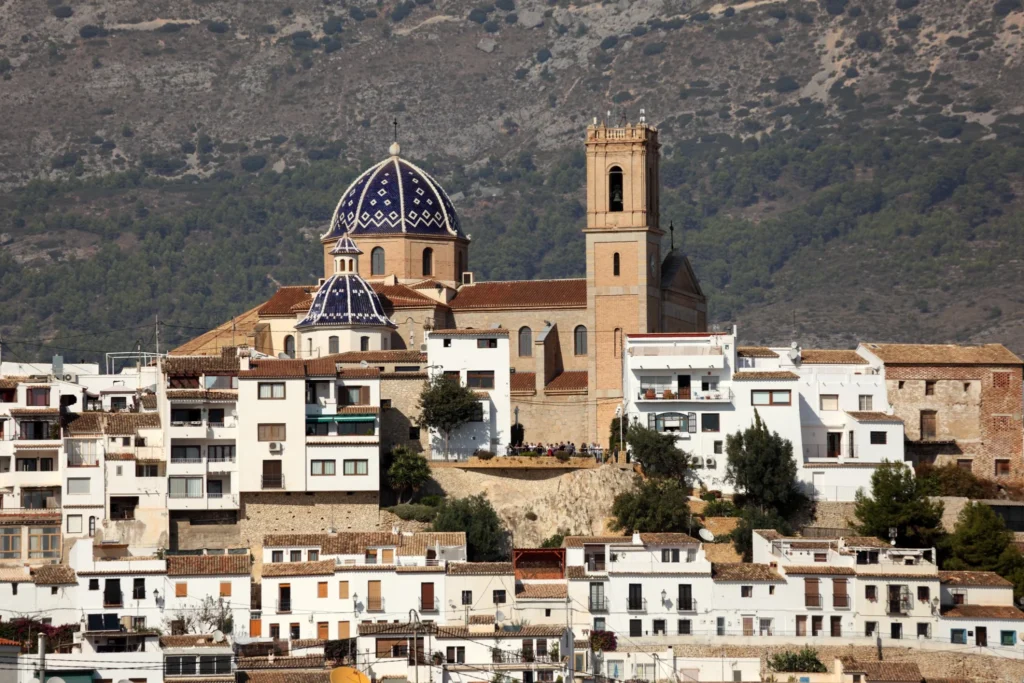
The church with the blue domes
The church of Nuestra Señora del Consuelo is the image of Altea, but it is younger than it looks. The previous church was pulled down in 1901 and the current one was consecrated in September 1910. The domes are covered in blue and white glazed tiles.
Entry is free; just avoid mass times. In autumn and winter there is mass on Tuesdays, Wednesdays, Fridays and Saturdays at 18:30, and on Sundays and public holidays at 9:00 and 12:00.
The square in front is the heart of the upper town. In July and August, from seven in the evening until past midnight, it is taken over by the Mostra d’Artesania craft market. If you want to see it empty, go in the morning.
Altea: discover its hidden history
What Altea was like centuries before the blue domes.
See the history of Altea
The viewpoints: which one depending on what you want to see
Altea has two main viewpoints and they face opposite directions.
The Mirador de los Cronistas de España, next to the church, faces south: the whole bay, the Serra Gelada and El Albir with its lighthouse in the distance. From there you understand why the two towns go together.
The Glorieta del Maño, next to the Portal Vell, faces north, towards the Sierra de Bèrnia and the coast of Calpe.
What you see from the viewpoint, up close.
See what to see in El Albir
Bellaguarda: the quiet part
A few minutes from the church, the Bellaguarda quarter keeps the watchtower and the old windmill. Far fewer people come here than to the church square.
Next to it is the Plaza del Agua, an open-air auditorium. On Thursdays in July and August, at nine in the evening, there are concerts in the Música a Boqueta Nit series.
Altea as you’ve never been told: corners and real life
Workshops, music and art: the other side of the upper town.
See artistic Altea
The promenade and the Algar footbridge
Down below, the seafront has been renovated: about 800 metres of coastline recovered, where there used to be a car park and there is now a promenade and beach.
At the southern end is what almost no guide mentions. The old iron railway bridge, from 1913–1915, is now a footbridge of more than 230 metres over the river Algar for walkers and bikes. Trains now run over the new viaduct right next to it.
If you are coming from El Albir, it is the natural way into Altea on foot.
Beaches of Altea: a guide to its coves and beaches
Which one to choose and what they are really like.
See the beaches
Altea la Vella
This is the original village, a few kilometres inland, and it feels like a different town: more rural, more for locals than visitors. The church of Santa Ana, built between 1882 and 1885, presides over a small square with the mountains behind. From there you can walk up to the Calvario.
The Russian Orthodox church
In Altea Hills, on the way to Calpe, there is a wooden church with golden domes that looks as if it had been brought from Russia. It was the first Russian Orthodox church on the Iberian Peninsula.
It opens from 9:00 to 18:00, and until 20:00 on Saturdays and the eve of public holidays. Visit in modest clothing and in silence.
How to get there from El Albir and where to park
Without a car, the TRAM takes you to Altea, the stop after El Albir; here is how to get to El Albir if you are coming from further away. On foot or by bike you follow the coast and enter town across the Algar footbridge.
By car, do not try to drive up to the old town. The easiest car park today is the one by the Algar river viaduct, with 274 spaces, 7 of them for people with reduced mobility, next to the footbridge. The other usual option is the one at the Fine Arts Faculty.
On Tuesdays there is a market from 8:00 to 14:00 in the Basseta car park, and that area fills up from early morning. The blue parking zone is changing: check the signs before you leave the car.
Albir vs Altea: which destination to choose
Stay in one and visit the other: the two towns face to face.
See the comparison
Frequently asked questions
Can I drive up to the old town?
It is not a good idea. It is pedestrian and there is no parking at the top. Leave the car below and walk up in 10 or 15 minutes.
Where should I park to see the old town?
In the Algar river viaduct car park, with 274 spaces, or the Fine Arts Faculty one. On Tuesday mornings, stay away from the market.
Can I go inside the church with the blue domes?
Yes, entry is free outside mass times.
What is the best viewpoint in Altea?
Cronistas de España for the bay and El Albir; the Glorieta del Maño to look north.
Which day is Altea’s market?
Tuesdays from 8:00 to 14:00, in the Basseta car park, next to the sports centre.
How do I get from El Albir to Altea without a car?
By TRAM, which is one stop, or on foot and by bike along the coastal promenade.
Is the old town accessible?
Only partly. There are slopes, cobbles and steps, and with a pushchair or wheelchair it is hard going.
To finish
Altea’s fixed sights can be seen in half a day, without rushing. Where to eat, where to sleep and which beach to swim at are in the Altea guide. And if you are coming from the neighbouring town or staying there, everything about El Albir is on the home page.
I'm Daniel and I've lived in El Albir since 2007. LiveinAlbir.com started because so many people would stop me in the street to ask where to eat, where to stay, which areas are worth it and what living here is really like.
Questions about El Albir? Write to me and I will get back to you.

