
Table of Contents
ToggleTHE FASCINATING HISTORY OF ALTEA: ORIGINS, LEGENDS AND MEDITERRANEAN CHARM
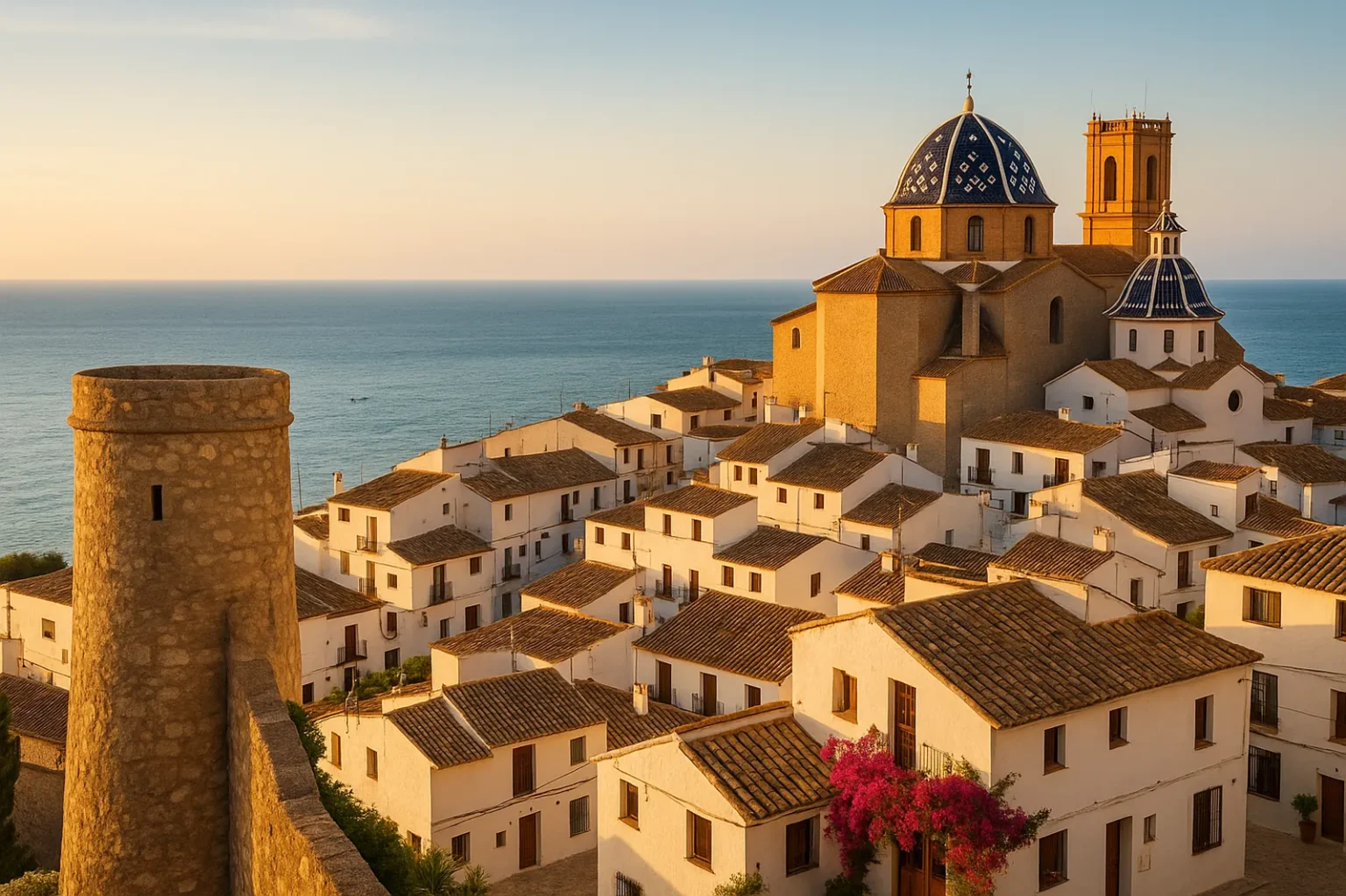
Walking today through the cobbled streets of Altea’s old town, with its whitewashed houses and the iconic blue domes of the church dominating the skyline, it’s hard to imagine that this corner of the Costa Blanca has witnessed thousands of years of history. Altea isn’t just a pretty postcard village: it’s a place where civilisations, legends and a unique Mediterranean character all cross paths. From the Iberians to modern-day artists, every era has left its mark on this bright town, open to the sea. In this article, we invite you to discover the fascinating history of Altea: a journey that will make you look at it with new eyes on your next visit.
EARLY SETTLERS AND ANCIENT ORIGINS
Altea’s origins go back long before it was founded as a Christian town. The area was inhabited as far back as the Neolithic period, as shown by remains found around the Sierra de Bernia. Later, during the Iberian era, significant settlements grew up in what is now Altea la Vella. Necropolises and pottery fragments from the 6th century BC point to Iberian communities engaged in trade and farming.
Its strategic position by the Algar river and facing the Mediterranean also drew Phoenicians, Greeks and Carthaginians. Some historians believe the name “Altea” may come from the Greek “Althaia” (she who heals), a nod to the healing properties the ancients attributed to the river’s waters. Others argue it comes from the Arabic “Atalaya”, referring to the watchtowers that once overlooked the coast.
ROMAN ALTEA AND ITS ROLE IN THE MEDITERRANEAN
During the Roman period in Hispania, the Altea area remained important. Remains of Roman villas, coins and pottery have been found, pointing to a steady presence. The Algar river and its mouth served as a small natural harbour, making it easier to trade farm and fishing produce.
While no evidence has been found of a major Roman city at Altea, its territory formed part of the province of Tarraconensis and served as a farming outpost supporting the larger coastal cities in the region.
THE MIDDLE AGES: CONQUEST, RESETTLEMENT AND DEFENCES
After the fall of the Roman Empire and the arrival of the Visigoths, the area went through a period of relative obscurity until the Muslim expansion. From the 8th century onwards, Altea came under the rule of the Taifa of Denia. The Muslims fortified the settlement and developed farming based on sophisticated irrigation systems, some of which are still in use today.
In 1244, King James I of Aragon reconquered the territory. To secure Christian rule, a founding charter (carta puebla) was granted in 1279 to encourage resettlement by Christian colonists. The defensive stronghold was built on what is now the Bellaguarda area, on high, walled ground.
Constant raids by Berber pirates led Altea to strengthen its defences throughout the 14th and 15th centuries. Coastal watch was organised around several towers, such as the Bellaguarda Tower and the Galera Tower.
FROM MEDIEVAL VILLAGE TO FISHING PORT
From the 17th century onwards, the town began to spread beyond its medieval walls. In 1617, a new charter was granted encouraging new settlers, which gradually drew the population towards the coast.
This shift was driven by economic reasons: as fishing and maritime trade grew, being close to the sea became increasingly attractive. This is how the seed of today’s Altea fishing port was planted.
At the same time, farming remained a key pillar of the local economy, with orange, almond and vine crops shaping the landscape.
18TH AND 19TH CENTURIES: GROWTH AND SEAFARING LIFE
During the 18th and 19th centuries, Altea saw notable growth in both population and economy. Its population passed 5,000 and maritime trade flourished. Altea’s fishermen became known for catching species prized in Mediterranean markets.
Architecturally, the town took on the look it has today: whitewashed houses, narrow streets and viewpoints opening onto the sea. This style wasn’t just about looks — it also helped protect against the summer heat.
Religious festivals and popular traditions took firm root during this period, many of which are still celebrated today.
THE 20TH CENTURY: THE ARRIVAL OF ARTISTS AND THE TOURISM BOOM
The 20th century brought major changes to Altea. During the 1950s and 1960s, numerous artists began settling in the town, drawn by its light, tranquillity and beauty. Painters such as Eberhard Schlotter, along with writers and musicians, found in Altea a creative refuge.
This phenomenon coincided with the start of tourism on the Costa Blanca. Unlike other towns that went for large-scale development, Altea managed to preserve its authenticity. Thanks to protective planning regulations, the old town keeps its traditional character today.
The tourism boom has brought prosperity, but Altea has managed to strike a balance between growth and conservation.
MONUMENTS AND HERITAGE THAT TELL THE STORY
Anyone visiting Altea today can immerse themselves in its history through its monuments:
- Iglesia de Nuestra Señora del Consuelo: with its unmistakable blue and white domes, it is the town’s icon. The present building dates from the early 20th century, built over an earlier church.
- Defensive towers: the Bellaguarda Tower and the Galera Tower recall the days when the coast was exposed to pirate raids.
- Altea la Vella: the original heart of the settlement, set further inland, still has a rural charm and historic remains.
- Ethnographic Museum: gives a full picture of how life in Altea has evolved.
Additionally, the old town’s own network of streets, viewpoints and squares is a living monument that breathes history.
FESTIVALS AND TRADITIONS ROOTED IN HISTORY
Altea’s festivals reflect its history and its identity:
- Moros y Cristianos: recalls the medieval past and the struggles between Muslims and Christians.
- Castell de l’Olla: a fireworks display over the sea, celebrating the town’s bond with its maritime surroundings.
- Fiestas de San Blas and San Juan: linked to farming traditions and rituals of renewal.
- Ruta de les Ermites: a religious and popular tradition that takes in various hermitages across the municipality.
These festivities not only keep Altea’s historical roots alive, they also strengthen its community spirit and its appeal to visitors.
CONCLUSION: A LIVING HISTORY IN EVERY CORNER
Altea isn’t just a lovely backdrop for postcards. It’s a place with soul, where every street, every stone and every festival tells a story that connects the past with the present.
Getting to know Altea’s history lets you appreciate its charm today on a deeper level: why its houses are white, why its old town remains intact, why art flourished here.
On your next visit, we invite you to lose yourself in its narrow streets, listen to the voices of its history, and discover for yourself why Altea is considered a jewel of the Mediterranean.

