
 Reviewed by Daniel · El Albir resident since 2007 · Updated November 2026 · Write to me
For years, going up to Polop castle meant climbing to some ruins with an old cemetery on top. Since May 2026 it’s a different story. The Diputación de Alicante has finished a restoration on which, according to its official statement, it spent €900,000. There are now walkways, information panels and consolidated walls, and it’s still free. Here’s how to get up there and what happened at the top, which is quite a lot. The practical side of the village (parking, market, fiestas) is in my guide to Polop de la Marina.
Contents
ToggleHow to walk up to the castle
The path from the old town
You walk up from the old town. From the church area, follow the streets that climb towards the Calvario: you’ll see the new restoration panels from the start of the climb. The south slope keeps the old zigzag path.
Where to leave the car
At the bottom, never at the top. The old town streets aren’t made for cars. Park in the lower part of the village and walk up.
What to bring
The climb is short but steep. In summer bring water, as there’s no real shade at the top.
Opening hours, price and accessibility
- Price: free.
- Opening hours: since reopening, the site can be visited freely. I haven’t found official council opening hours or any news of security staff, so if you’re going very early or late, check with the tourist office (626 001 089).
- Don’t get confused: the cemetery opening hours you’ll see on polop.org are for the current municipal cemetery, not this one.
- Accessibility: the route is easy and much of it runs on wooden decking, but the hill sets the rules. It isn’t suitable for wheelchairs and it’s hard going with a pushchair.
Local tip: go up at sunset. It’s what people mention most in reviews, and they’re right: the light over the Puig Campana and Benidorm bay is worth the climb. Just come down before it gets fully dark.
What you’ll see at the top
Walls, cistern and tower
Stretches of rubble-stone and rammed-earth wall remain, part of the double enclosure, the cistern that supplied the fortress and the remains of the main tower. The restoration included archaeological digs, and one of the conclusions is that much of the castle’s stone ended up in the village houses.
Gabriel Miró’s garden of crosses
In the 19th century the fortress became a cemetery, and it stayed one until burials moved elsewhere in the mid-20th century. Gabriel Miró described it in “Huerto de cruces” (Garden of crosses), one of the pieces in Años y leguas (1928). In 2013 the council restored it following that text and the memories of older residents. Today there are headstones, references to the writer and a bust. Nobody is buried here any more, but it’s still a place for respect.
The views
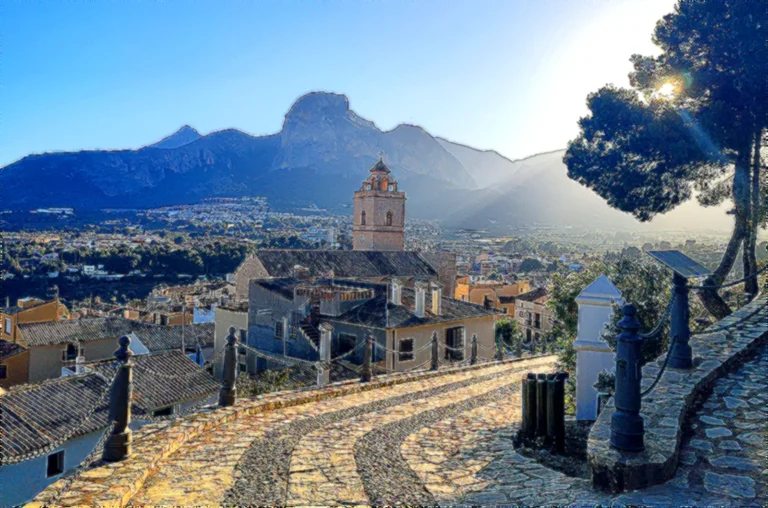
From the top you can see the Ponoig, the Puig Campana, the valley towards La Nucía and the sea in the distance.
The castle’s history, without the embellishments
Andalusí origins and El Cid
The castle dates from the Almohad period, the 12th and 13th centuries, on a hill that controlled the route between the interior and the coast. The Historia Roderici, a medieval chronicle, records that El Cid occupied Polop around 1089–1090. That part comes from the chronicle; the stories of treasure and caves you’ll hear in the village are legend.
Jaume I, Al-Azraq and the barony
After the Treaty of Almizra (1244), Polop became part of the Crown of Aragon. The area lived through the uprisings led by Al-Azraq. In 1268 Jaume I granted the place to Berenguela Alfonso, and on 6 June 1271 he gave it to the Bellpuig family, according to the University of Valencia’s register of lordships. It names Bernat de Bellpuig, though many websites call him Beltrán. It then passed to Admiral Bernat de Sarrià and to the House of Aragon. In 1448 Diego Fajardo received the residents’ homage as the new lord. The Fajardo family held the barony of Polop until the 19th century. The barony once included La Nucía, which broke away in 1705.
August 1521: the Germanías massacre
On 18 August 1521, Vicent Peris’s agermanados (rebels of the Germanías revolt) reached the castle, where the Mudéjars of the area had taken refuge. A surrender was agreed on condition that they were baptised, and afterwards they were killed. How many died is still debated: old chroniclers speak of around 600, other accounts of more than 800, and a recent academic study gives a range of 800 to 2,000. I’d rather give you the range than a round number nobody can prove.
1609 and what came after
With the expulsion of the Moriscos in 1609, Polop lost a large part of its population. The castle gradually lost its military role, was used as a quarry and, later, as a cemetery.
Did the cemetery win an award?
As far as I’ve been able to check, no. It was a finalist in the Adiós Cultural magazine cemetery competition in 2016, in “Best documented history”, and in 2019, and it entered again in 2022. Reaching the final says a lot for a village cemetery, but it isn’t the same as winning.
To round off the day
Head down to the Plaça dels Xorros and carry on with the walk through Gabriel Miró’s Polop and the water route. If you like castles, Guadalest is a short drive away. For food, getting there and everything else about the village, go back to the practical guide to Polop. And for more plans in the area, there’s the El Albir guide written by a local.
Frequently asked questions
Do I need to pay or book to visit the castle?
No. Access is free and no booking is needed.
Can I go up with children?
Yes. The route is short and easy. At the top, keep an eye on them near the walls.
Is Gabriel Miró buried in Polop?
No. Miró spent his summers in Polop from 1921 to 1928 and wrote about this cemetery, but he isn’t buried here.
Who paid for the restoration?
The Diputación de Alicante, with €900,000 spread over several phases, according to its official statement. The European funds mentioned in the area belong to a different project, the Water Route with La Nucía.
Is the story of the Morisco massacre true?
Yes, it’s well documented. What’s debated is the number of victims, which ranges from around 600 to 2,000 depending on the source.
I'm Daniel and I've lived in El Albir since 2007. LiveinAlbir.com started because so many people would stop me in the street to ask where to eat, where to stay, which areas are worth it and what living here is really like.
Questions about El Albir? Write to me and I will get back to you.