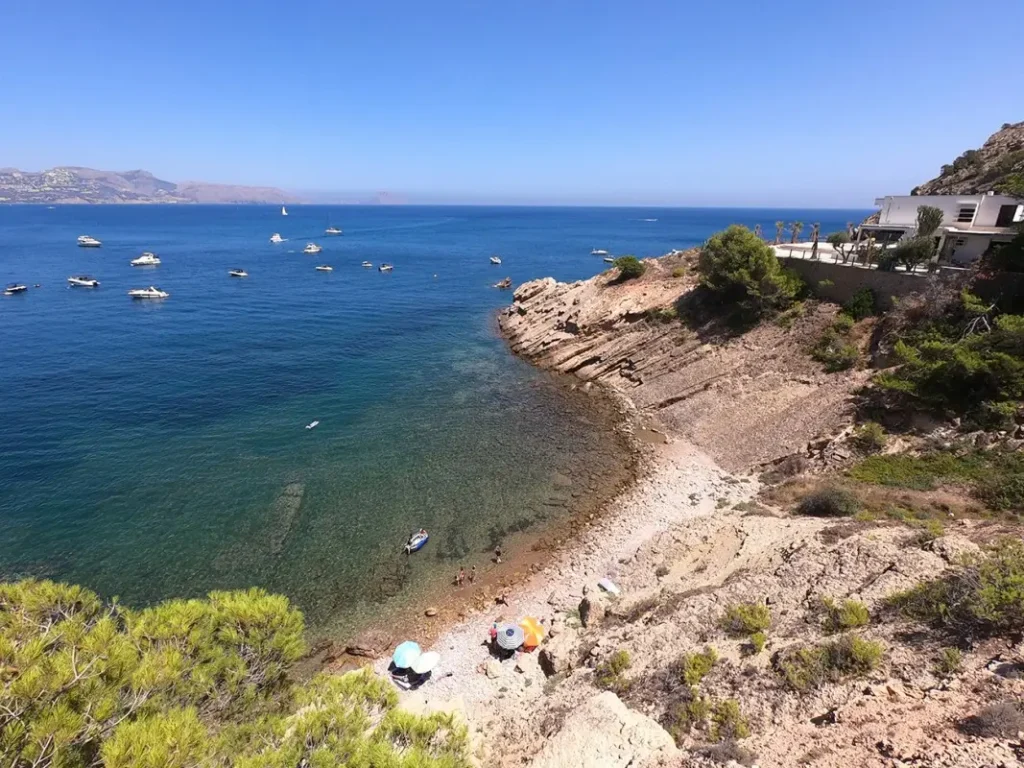
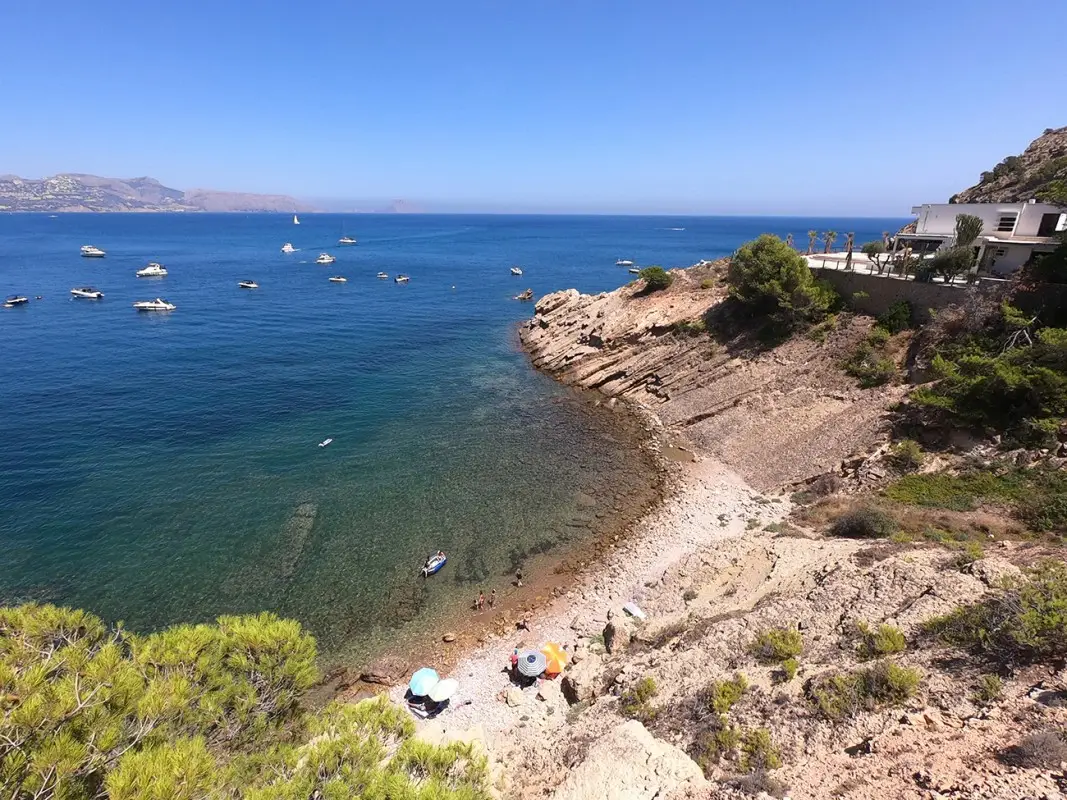
On the northern coast of the province of Alicante, between the towns of Benidorm and Altea, lies El Albir, the coastal district of the municipality of l’Alfàs del Pi. Although this stretch of coast is best known for the urban beach of Racó de l’Albir, one of its best-kept secrets lies just a few metres to the east: the Amerador Cove. This tiny cove of pebbles and rock measures barely 20 m long by 7 m wide. Thanks to its small size and difficult access, it has become a true haven of peace within the Serra Gelada Natural Park. Its clean waters, the richness of its seabed and the surrounding scenery make it one of the most prized spots for anyone looking for something different, away from the bustle of the main beaches.
This article takes a close look at everything surrounding Cala del Amerador: its geography, origins, natural value, cultural history, what it offers visitors and how to help protect it. To put it together, we consulted official sources, environmental guides and local websites, with the aim of offering a text that is both rigorous and detailed.
Location and surroundings
On the lower slopes of the Serra Gelada
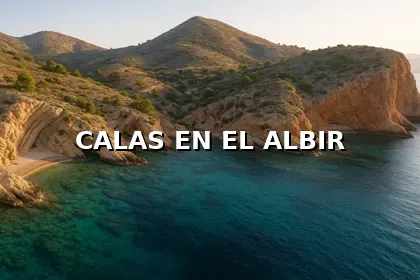
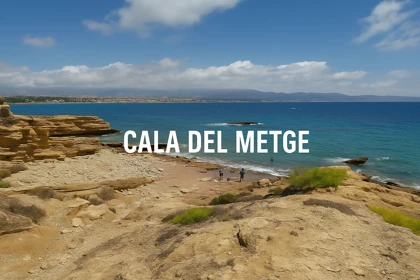
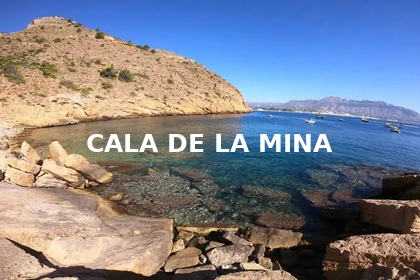
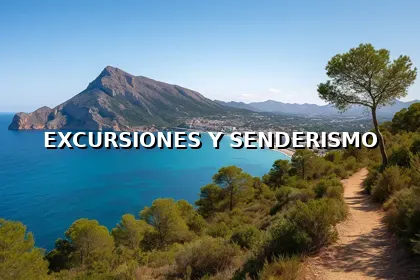
Cala del Amerador sits on the western slope of the Serra Gelada, within the municipality of l’Alfàs del Pi. It lies at the foot of the Morro del Metge, very close to the Las Sirenas viewpoint and the El Albir lighthouse. It is one of a group of three small coves —Metge, Mina and Amerador— that emerge between the cliffs of the natural park. The Serra Gelada is the first combined land and marine natural park in the Valencian Community; of its 5,564 ha of protected area, 4,920 ha is sea. As well as spectacular cliffs more than 500 m high, the park preserves Posidonia oceanica meadows that oxygenate the water and shelter numerous species of fish and crustaceans.
From the Amerador viewpoint, just a few minutes from El Albir, there are panoramic views over Las Sirenas cove and El Albir beach. A Minube traveller comments that, although getting down to the cove is tricky, the effort is worth it because the cove “is stony, has few people around and is recommended for snorkelling when there is little swell.”
Physical characteristics of the cove
According to the official beach listings, Cala del Amerador has the following characteristics:
Size: roughly 20 m long and 7 m wide.
Composition: a seabed of rock and pebbles, with moderate swell.
Crowds: low. It is considered a secluded beach that rarely gets busy.
Upkeep: even though it is a cove with no tourist facilities, it has a cleaning service.
Type of beach: some websites describe it as nudist, while other guides say it is simply a place where naturism is practised voluntarily and respectfully.
Access: the cove can only be reached on foot along a path of about 100 m that descends from the Las Sirenas viewpoint; it is a narrow and stony track in poor condition and with a risk of rockfalls. There is no dedicated parking area, so it is best to leave your vehicle in the designated area next to the El Albir lighthouse and continue on foot.
Marine environment
Amerador lies within the Serra Gelada marine protected area, where strict rules are in place to protect biodiversity. The Camí del Far de l’Albir guide explains that part of the fishing activity in the Bay of Altea has stopped using natural fibres such as hemp or esparto and that, to protect the Posidonia meadows, eco-friendly buoys have been installed to prevent indiscriminate anchoring. Park regulations prohibit free anchoring and limit boat speed to 3 knots in certain areas. Professional trawl fishing is banned within 1.5 nautical miles of the coast to avoid damaging the seabed.
History and origin of the name
Soaking esparto
The verb “amerar” means to submerge in water. Cala del Amerador takes its name from an old agricultural practice: soaking esparto. Esparto (Stipa tenacissima) is a Mediterranean grass whose leaves have been used since ancient times to make rope, baskets, espadrilles and other items, thanks to their great toughness. To work the material, bundles of leaves were cut and left to soak in seawater for weeks to soften them; they were then beaten and braided.
The municipal guide to the Camí del Far explains that in the little cove of l’Amerador, bundles of cut esparto were left to soak so they would soften and be easier to work. That is why the place came to be called Amerador. The Generalitat Valenciana notes that farmers from the nearby mountains —Xixí, Ballestera and les Puntes de Gosàlvez— would submerge freshly cut esparto here to make farm tools, household utensils and even footwear.
Traditional activities and the ochre mine
The Serra Gelada has been put to a range of uses over the centuries. Besides soaking esparto, people also worked ochre mines in the 19th century. According to the guide to the Camí del Far, the remains of a small ochre mine survive in a ravine near the lighthouse route: the channels and the foreman’s house are still standing, and a line of pillars was used to lower wagons of ore down to the shore. Once on the coast, the ore was loaded onto boats that carried it to a ship anchored in the bay, bound for the port of Dénia. At the southern end of the Serra Gelada, in the cove of Ti Ximo, there was another mine, this one extracting limonite, a yellow mineral similar to ochre.
Mining in the area was organised through concessions granted by the central government; a handful of businessmen obtained the licences and hired local foremen. The ochre mine at l’Albir was run in the late 19th century by Esperanza Devesa while her husband emigrated to Algeria to work.
Piracy and coastal defence
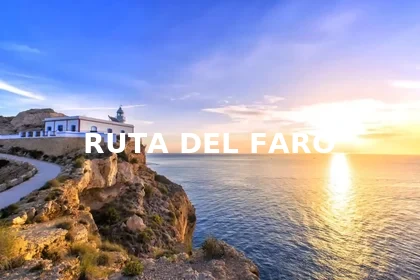
During the Early Modern period, the Mediterranean coast suffered frequent raids by Barbary pirates. King Philip II ordered watchtowers to be built to warn of approaching enemy ships. One of these defensive towers was the Torre Bombarda, built at the northern end of the Serra Gelada. In the 19th century the site was used to build the El Albir lighthouse, inaugurated on 30 April 1863 as part of the National Maritime Lighting Plan. Standing 112 m above sea level, the lighthouse has guided sailors in the Bay of Altea ever since.
Geology and palaeontology of the Serra Gelada
The Serra Gelada stands out for its remarkable geology. This mountain range features cliffs of limestone rising above 400 m and a summit of 438 m above sea level. The experts at Espores point out that the park’s steep terrain originated in tectonic movements which, as they raised the land, created a sharp slope down to the sea. The mountain preserves a hanging fossil dune, formed thousands of years ago from wind-blown sand that was later fossilised  welcomelalfas.com.
Along the lighthouse trail you can see geological folds in the walls of the coves; one photogenic fold is visible on the right-hand wall of Cala del Amerador itself. These formations bear witness to the tectonic processes that shaped the Serra Gelada.
Flora and fauna
Mediterranean vegetation
The vegetation on the western slope of the Serra Gelada is adapted to drought and limestone soil. The park holds plant micro-reserves and endemic species such as Linaria arabiniana and Biscutella montana. There is also scrub made up of rosemary, heather, juniper and esparto, along with old olive and carob trees that give the landscape a traditional agricultural character. The Camí del Far guide includes a botanical profile of the carob tree (Ceratonia siliqua), an evergreen that can reach 15 m and whose fruits (carob pods) were traditionally used to feed livestock.
Along the shoreline grow salt-tolerant shrubs such as ephedra (Ephedra fragilis) and protected rock-dwelling species such as the Ifach campion (Silene hifacensis). Some plants, such as the Ifach germander (Teucrium hifacense) and common smilax (Smilax aspera), take refuge in the cracks of the rock walls.
Posidonia and marine ecosystems
The ecological value of Cala del Amerador lies in its shallow seabed, colonised by Posidonia oceanica. This seagrass is essential to the ecosystem: it produces oxygen, traps sediment and provides shelter and food for a multitude of species welcomelalfas.com. The park’s regulations strictly protect the Posidonia meadows, banning free anchoring and restricting fishing.
The waters of the Serra Gelada are home to fish such as white seabream (Diplodus sargus), rainbow wrasse and saddled seabream, as well as molluscs and crustaceans that find refuge in the meadow. The area is frequented by bottlenose dolphins (Tursiops truncatus) and seabirds such as the Mediterranean shearwater (Hydrobates pelagicus melitensis).
Land animals and birds
The cliffs are home to birds of prey such as the peregrine falcon and the European shag, as well as the yellow-legged gull. In the scrub live reptiles such as the Podarcis hispanicus (Iberian wall lizard) and small mammals. The trail to the lighthouse lets you see the carob and the Aleppo pine (Pinus halepensis), the tree that gives its name to the municipality of l’Alfàs del Pi.
How to get there and tips for visitors
Access routes
By land: The most common way to reach Cala del Amerador is on foot from the car park at the El Albir lighthouse. From there, take the Paseo de l’Amerador, a 2.5 km paved path that leads to the lighthouse. Just before you reach the lighthouse you will come to the Las Sirenas viewpoint; from this point a dirt track of about 100 m that leads down to the cove. The path is narrow, uneven and stony in places, so it’s worth wearing suitable footwear, and it’s best avoided with small children or anyone with reduced mobility.
By sea: You can also get there by kayak, paddle board or boat from the beach at Racó de l’Albir or from the port of Altea. Boats must anchor at the authorised eco-friendly buoys so as not to damage the Posidonia.
Rules of use and safety
The Serra Gelada Natural Park has rules designed to protect the environment and keep visitors safe. The main ones are:
Stick to the marked trails: leaving the paths is prohibited.
Water and suitable equipment: bring enough water, a hat and appropriate footwear, as there is no shade or drinking water along the route.
Pets and bikes: dogs must be kept on a lead, and bicycles and scooters may only be used outside peak hours (10:00–20:00).
Prohibitions: camping, lighting fires and picking plants are not allowed; fishing and diving are regulated, and wildlife must be respected.
Waste: all rubbish must be taken away with you; Cala del Amerador has no bins or cleaning services in the bathing area, although the municipality provides a basic service.
Activities and experiences
Snorkelling and amateur diving
Thanks to its rocky bed and the presence of Posidonia, Cala del Amerador is an excellent place to get started with snorkelling and diving. The l’Alfàs del Pi tourism website says the cove is ideal for amateur diving; its rocky terrain and shallow seabed make it a perfect spot to explore underwater life. Visitors praise the clarity of the water and recommend snorkelling when the sea is calm.
Kayaking and paddle boarding
The nearby port of Altea and El Albir beach make it easy to explore the coast by kayak or paddle board. Following the advice in the Camí del Far guide, many paddlers skirt the cliffs from the cove, head towards Cala del Metge and Cala de la Mina, and take in the geology and the Posidonia meadows. The park prohibits access to restricted areas such as Benidorm Island or Isla Mitjana, and limits boat speed to protect wildlife.
Hiking and photography
The route to Cala del Amerador is part of the El Albir lighthouse trail, a pleasant 2.5 km paved walk that is accessible to people with reduced mobility as far as the viewpoint. From there you can take in a panorama of the Bay of Altea and the Peñón de Ifach. Along the way there are information panels on geology, vegetation and wildlife, as well as the remains of the ochre mine and the cistern dating from the 16th century, used by the soldiers of the Torre Bombarda. The cove is an excellent setting for landscape photography, thanks to the Mediterranean light and the contrast between the reddish rocks, the blue sea and the vegetation.
Naturism and tranquillity
Although the cove is not officially listed as a nudist beach, some sources say it is frequented by naturists. The portal InSpain describes it as a nudist beach with moderate waves, while other sites warn that it is a natural setting where naturism is practised voluntarily and respectfully. Either way, the low occupancy means you can relax without crowds, read a book or simply gaze at the horizon.
A cultural and social hub in l’Alfàs del Pi
Racó de l’Albir and life in El Albir
L’Alfàs del Pi, a name of Arabic origin meaning “fertile field”, became independent from Polop in 1836 and took its current name in honour of the pine tree that was planted in the square in 1786. The municipality has seen strong population growth: from 250 inhabitants in the 19th century to more than 21,000 today, with over 90 nationalities.
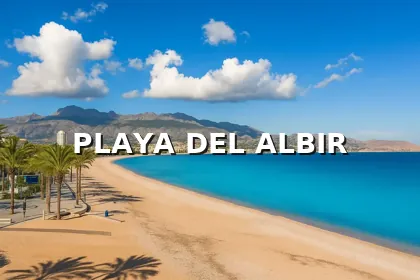
The Racó de l’Albir, the town’s main beach, stretches along the Bay of Altea between the Serra Gelada and the Peñón de Ifach. Its shoreline of rounded pebbles has tourist facilities and has held the Blue Flag since 1987. The seafront promenade is home to the beach library, playgrounds and areas for water sports such as canoeing, paddle surfing, sailing and windsurfing. An article on water activities stresses that the seabed of the bay falls within the protected area of the Serra Gelada, with a Posidonia meadow and a great variety of species, which is why eco-friendly buoys have been installed to prevent anchoring.
Sustainable tourism and local culture
The tourism boom in l’Alfàs del Pi has not stopped the municipality from promoting a sustainable tourism model. The El Albir tourist office presents itself as the ideal place to find out about routes, nearby coves —including Cala de Amerador and Cala de la Mina— and the activities available, while stressing the need to respect the environment.
Besides its natural resources, l’Alfàs del Pi offers cultural attractions such as the Frax Foundation, a building dedicated to art and culture; the golf practice range on Bulevar de los Músicos; and numerous sculptures and murals dotted along the seafront promenade. Each year the municipality hosts the l’Alfàs del Pi Film Festival and the Estiu Festiu fair in the Plaza del Ancla.
Practical tips and recommendations
Plan your visit: Cala del Amerador has no facilities such as toilets, showers or beach bars. Bring water, food, a sunshade and rock shoes. As there is no shade, it is best to avoid the middle of the day.
Respect the surroundings: do not remove stones or vegetation. Remember that the park guide prohibits picking plants and straying from the paths. Take any rubbish back with you.
Sea safety: check the state of the sea. Although the swell is usually moderate, rough seas can make getting in and out over the rocks dangerous. Wear neoprene shoes to avoid slipping.
Access with children or older people: the steep path is not suitable for pushchairs or wheelchairs; think carefully about the visit if anyone has reduced mobility.
Photography tip: go early or at sunset to enjoy the golden light on the rocks. The Amerador viewpoint offers spectacular views of the cove and the horizon.
Conclusion
Cala del Amerador is much more than a tiny rocky beach: it is a living testament to Mediterranean culture and nature. Its name recalls the old trade of soaking esparto to make everyday objects; its cliffs hide the story of the ochre mines and of the watchtowers that protected the coast from pirates; its seabed holds Posidonia meadows and shelters fish, dolphins and seabirds.
Visiting Cala del Amerador means taking on a commitment to conservation: follow the marked paths, reduce your footprint and respect the flora and fauna. In return, visitors get an incomparable reward: a swim in crystal-clear water, the thrill of exploring a wild landscape, the peace of a place few people visit, and the chance to connect with the history of l’Alfàs del Pi.
On a coast dominated by urban beaches and mass tourism, hidden corners like Cala del Amerador remind us that there are still spaces for contemplation, adventure and harmony with nature. May responsible enjoyment of it help preserve it for future generations.
Sources consulted:
- spain.info
- espores.org
- abahanavillas.com
- minube.com
- alicantedirectorio.com
- img.mesvilaweb.cat
- comunitatvalenciana.com
- parquesnaturales.gva.es
- asovitur.com
- welcomelalfas.com
EXPLORE OTHER COVES AND AREAS OF EL ALBIR: