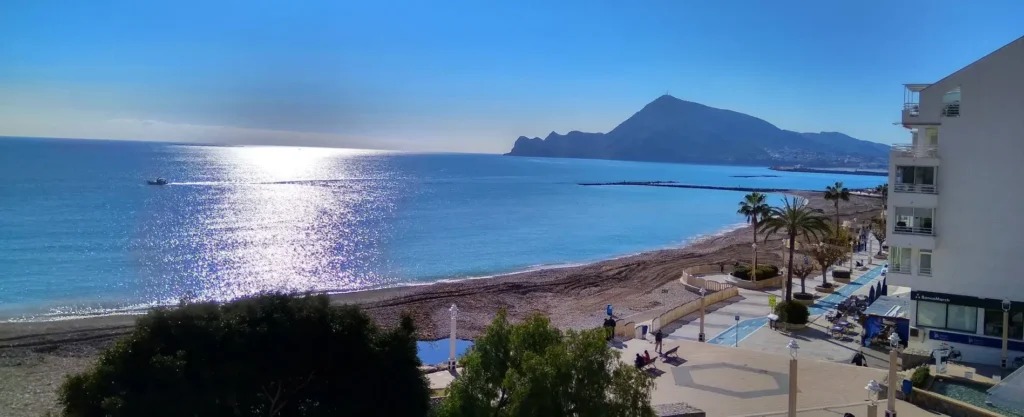
The beaches of Altea stretch across 8 km of Costa Blanca coastline: hidden coves, pebble beaches and clifftops with remarkable views. Spots like La Roda, Cap Negret and La Olla offer crystal-clear water and the kind of calm that makes for great swimming and snorkelling. This guide covers access points, services and local details to help you find your favourite corner of the Mediterranean.
WHERE ARE ALTEA’S BEACHES?
Here’s a quick geographical overview: the Altea coastline runs from Cap Blanch in the south — where it meets Albir Beach — all the way north to the Mascarat coves, which mark the border with Calpe. Along that stretch, from south to north, you’ll find the following main beaches and coves:
Cap Blanch Beach – The southernmost point of Altea, in the bay adjoining Albir.
La Roda Beach – The urban beach facing Altea’s old town.
L’Espigó Beach – A small beach next to the harbour, also known as the Escollera beach.
Cap Negret Beach – A wide gravel stretch north of the town centre, below the Sierra de Bernia.
Cala del Soio – A rustic cove tucked between Cap Negret and the La Olla area.
L’Olla Beach – A peaceful beach facing the Illa de l’Olla, about 3 km from Altea town centre.
Playa de la Solsida (Galera-Solsida) – A small natural cove in the northern part of Altea, close to Altea Hills.
Mascarat Beaches – Several coves around Punta Mascarat, including Mascarat Beach (next to Campomanes marina) and wilder coves such as Barra Grande on the border with Calpe.
We’ll take you through each one in detail — the type of beach (sand or stone), how to get there and where to park, what services are available (beach bars, showers, and so on), the atmosphere, and a few local facts worth knowing. At the end you’ll find a comparison with the neighbouring beaches of Calpe, Albir and Jávea, plus a FAQ section to help you decide which Altea beach suits you best. Let’s start this tour of Altea’s coastline.
CAP BLANCH BEACH (CAP BLANC)
Location: The coastal tour of Altea begins at Cap Blanch, the southernmost beach in the municipality, sitting right on the border with El Albir (L’Alfàs del Pi). Cap Blanch is the natural continuation of Albir Beach, and together they form a wide shared bay between the two towns.
Type and atmosphere: Cap Blanch is a long beach of gravel and rounded pebbles, with some sandy stretches mixed in. The water is blue and clean — great for swimming, though water shoes are a good idea given the stones underfoot. It’s an open, spacious beach, ideal for long walks along the shore or water sports, thanks to the generally calm sea. The sheer size of it means there’s usually room even at the height of summer, giving it a relaxed, family-friendly feel.
Access and parking: The beach runs alongside Altea’s southern promenade, near the Altea marina. Access from the road and port is straightforward, with street parking nearby and spaces close to the harbour. Accessibility is good, with wooden walkways over the pebbles in season and adapted access at certain points for people with reduced mobility.
Nearby services: In summer Cap Blanch has the basics covered — lifeguard posts, showers, footbaths, bins and sunbed rental. Being right next to the marina and promenade, you’ll find beach bars and restaurants just a short walk away, particularly towards the Albir end. Windsurfing and paddle surfing are common here thanks to the gentle breeze that comes into the bay. Camping Cap Blanch is nearby, and the centre of Albir — with supermarkets and all other services — is just a short distance away.
Local notes: The views north from Cap Blanch are stunning — Altea village in the middle distance and the bold silhouette of the Peñón de Ifach at Calpe on the horizon. At sunset the Sierra de Bernia turns extraordinary colours behind the beach. A historical curiosity: Cap Blanch is home to the remains of a Civil War bunker, now submerged just off the shoreline. On clear days you can make out its structure beneath the water from the promenade that connects with Albir Beach.
Internal links: A dedicated Cap Blanch guide is coming soon. And if you’re thinking about staying or living near here, the Cap Blanch/Albir area offers a calm, well-established residential feel — check our rental options to see what’s available locally.
LA RODA BEACH
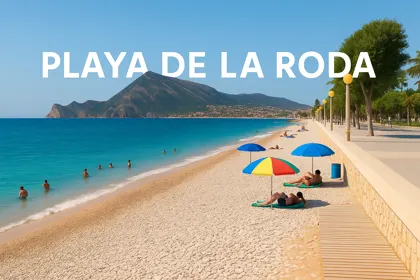
Location: La Roda is Altea’s main urban beach. It stretches from near the fishing and leisure harbour all the way to the mouth of the River Algar to the north, running right alongside the old town and town centre. Step off the seafront promenade and you’re already on La Roda — making it as easy as beaches get for anyone staying in the village.
Type and atmosphere: It’s a wide beach of rounded pebbles and white gravel, with a generally calm sea. La Roda is Altea’s most popular beach and draws families, tourists and locals in summer, yet it never gets as packed as the sandy beaches further along the Costa Blanca, so the atmosphere stays pleasant. The water is clear and safe for children (with supervision) — the gradient into the sea is gentle even if the bottom is stony. Many people describe it as lively yet balanced, combining comfort with natural beauty. The backdrop of mountains and Altea’s old town perched on the hillside makes it genuinely picturesque.
Access and parking: Being right in the town centre, La Roda has a wide palm-lined promenade and is easy to reach on foot from anywhere central. Parking is available near the harbour and in side streets, though spaces fill quickly in summer — arriving early or using public transport is a good idea. There’s a nearby bus stop and a TRAM station a few minutes’ walk away. The beach is fully accessible for people with reduced mobility, with ramps, walkways to the water and amphibious wheelchairs available in season. La Roda holds the Blue Flag during the summer months.
Nearby services: Everything you’d expect from an urban beach — lifeguard posts, showers, footbaths, sunbed and umbrella rental, play areas, and plenty of ice cream parlours, cafés and restaurants right across the promenade. The food options range from a casual terrace ice cream to a proper sit-down rice dish with a sea view. In summer there are also water sports on offer: paddle board and kayak rental, and short courses from local water sports schools. With all its facilities and its position at the heart of the village, La Roda is Altea’s most family-friendly beach.
Reputation: Anyone visiting Altea tends to start with a swim at La Roda. Visitors consistently praise how clean and well-kept it is, and the views across the bay to the mountains. The promenade is described as lively, with restaurants right on the beachfront. It’s worth noting it’s a pebble beach, not sand, so a thick mat or proper sunbed makes a difference. Most people agree it’s unmissable in Altea for its unique atmosphere — many come back year after year.
Internal links: Find out more in our dedicated article on La Roda Beach in Altea, with information on nearby activities and comparisons with other Altea beaches. And if you fall for this place and dream of waking up to sea views every day, take a look at the rental options in Altea.
L’ESPIGÓ BEACH (ESCOLLERA)
Location: L’Espigó (also known as Escollera beach) is a small beach just north of Altea harbour, separated from La Roda by the harbour breakwater. It was partly reclaimed from an area that had previously disappeared, adding an extra stretch of beach right in the town centre. It sits at the foot of the promenade, next to the breakwater that protects the port.
Type and atmosphere: It’s a small pebble beach, similar in composition to La Roda but much smaller — around 100 metres long. Very central and usually quiet. Being less well known, it sees fewer bathers than La Roda, apart from local families with young children or people looking for a calmer spot within the village itself. Its sheltered position behind the breakwater means the water is extremely calm — almost a natural pool on windless days. For that reason it’s particularly popular with children and older swimmers who want to get in the water without any wave action at all.
Access and services: Right next to the La Roda promenade, it shares the same easy urban access. Steps and ramps lead directly down from the seafront. In season, l’Espigó shares lifeguard coverage with La Roda given how close they are, and has bins and basic maintenance. There are no dedicated showers (the nearest are at La Roda a few metres away), and no beach bar on the beach itself — but cross the road and you’ll find ice cream shops and cafés. Its main advantage is maximum accessibility and proximity to all town centre services.
Special atmosphere: The calm water and easy entry make it popular with families with young children, who can splash around near the shore with minimal wave action. It’s also used by locals who live nearby and prefer to avoid the busier stretches. In summer some people use it as a dog-friendly beach during permitted hours, although Altea’s official designated dog beach is in the northern area near Mar y Montaña at La Olla. Check with the tourist office for current rules if you’re travelling with a pet.
Worth knowing: L’Espigó has direct views of the yacht club and harbour — you can watch boats coming and going while you swim. Its central location makes it a great vantage point for maritime events; during local festivals or nautical events, this spot is a natural grandstand. As part of Altea’s seafront, this little beach adds to the postcard picture: in a single glance you get the harbour boats, the calm sea, the white pebbles and the old town rising behind.
Internal links: We’ll be dedicating a full page to this charming little beach soon. If you’re looking to live in Altea’s town centre with the beach just steps away, explore our Altea property guides — starting the day with a swim at l’Espigó could be your daily routine.
CAP NEGRET BEACH
Location: Continuing north, past the mouth of the River Algar, begins Cap Negret Beach. This long stretch of coastline covers approximately 2 km, from the Algar area (north of the town centre) to the small Cala del Soio that marks its northern end. The beach takes its name from the Punta Cap Negret, a dark volcanic headland that juts slightly into the sea. Behind the beach sits the Cap Negret hotel, and inland the spectacular Sierra de Bernia frames the whole scene.
Type and atmosphere: Cap Negret is an open, semi-urban beach of gravel and rounded pebbles. Its distinctive feature is a scattering of dark, grey-black stones in certain stretches — the result of ancient volcanic formations in the area (hence the name, which means Black Cape in Valencian). This gives it a character unlike any other beach in Altea. The water is very clean and clear, great for swimming and snorkelling. Divers often highlight the rich marine life around Cap Negret, where the volcanic rocks create interesting underwater ecosystems. The atmosphere is generally quieter than La Roda — a retreat for those after nature and peace, with plenty of room to lay a towel even in high season. Its length means it never feels overcrowded.
Access and parking: The beach runs parallel to the old N-332 national road, which gives several access points. You can drive and park in the surrounding streets — many of the nearby residential developments and the hotel have their own parking. On foot or by bike, a pedestrian path connects from the Algar area along the whole of Cap Negret, making it a pleasant ride or walk beside the sea. It’s only 2 km from Altea town centre, and some visitors walk the whole way from La Roda. There’s a bus stop and TRAM station near the Cap Negret hotel, so public transport is a viable option. The beach has some wooden walkways in summer to help cross the stone sections, though it’s less urban in feel than La Roda.
Nearby services: Despite its more natural character, Cap Negret has seasonal services — lifeguards, footbaths, bins, and some stretches with sunbeds and umbrellas for hire. Pedalo and paddle board rental are usually available in summer too. At the southern end near the Algar, a couple of beach bars serve cold drinks and fresh paella — in the gravel, technically, not the sand. The four-star Hotel Cap Negret has a restaurant and café open to non-guests, and there are other local businesses along the road. Further north, approaching Cala del Soio, the area becomes more residential and quieter.
Reputation and highlights: Cap Negret is well known among snorkellers and divers. The clear water and rocky bottom mean you can spot fish easily, especially near the cliffs below the headland. Visitors regularly mention the beauty of the dark volcanic rock formations against the blue sea. There’s also a historical layer worth knowing: Cap Negret has one of Altea’s Civil War bunkers — almost hidden among the pebbles and partially flooded by the sea. This 1937 structure, along with another at La Olla beach, are the last surviving bunkers in Altea. It’s not unusual to see curious visitors peering inside, though the interior is damp and care is needed. History, nature and quiet make Cap Negret genuinely special. Many people consider it the best place in Altea to sit with a book and listen to the waves, or to have a picnic under the pine trees that dot the coastline in places.
Internal links: A complete Cap Negret guide is coming soon, including nearby walking routes (such as the path to the Albir Lighthouse that starts from this area) and practical tips. Its peaceful character also makes it a sought-after place to live — the Cap Negret/La Olla neighbourhood has villas and apartments with sea views. If that appeals to you, take a look at the Altea property section where we cover living in areas like Cap Negret.
CALA DEL SOIO
Location: At the far end of Cap Negret beach, marking the transition towards the La Olla area, lies Cala del Soio. This small rustic cove sits right on the boundary between the Cap Negret and l’Olla districts of Altea, next to a tiny traditional boat harbour (the Portet de l’Olla) and beneath a pine grove, in a semi-urban but very quiet setting.
Type and atmosphere: Cala del Soio is tiny — large rounded boulders and rock, with incredibly clean water. It’s largely unknown to the casual visitor, which gives it an intimate, unhurried feel. Only a handful of families or small groups can fit here at once, and it tends to be used almost exclusively by residents of the traditional low-rise houses built facing the sea in that area. It feels like a secret cove, surrounded by nature, where the only sound is the sea. Because of its hidden character and slightly tricky access, many people describe it as a cove for adventurers or those in search of total peace.
Access and parking: Cala del Soio is only accessible on foot. You get there by turning off the road that crosses Cap Negret towards the l’Olla area, along a path that leads to the Portet (the small harbour). From wherever you leave the car, it’s a few minutes’ walk. The exact access is poorly signposted — essentially you follow the edge of the l’Olla small harbour and descend via rocky paths. It’s not suitable for people with reduced mobility, and not recommended for young children unless you’re very careful on the uneven terrain. Parking is limited due to the narrow residential streets — arriving early helps. Those who don’t want the walk can always arrive by swimming or kayak from nearby l’Olla beach, which is a small adventure in itself.
Services: Don’t expect tourist facilities at Cala del Soio — that’s part of its appeal. No lifeguard, no beach bar, no public toilets. Just pine trees and the installations of the tiny harbour next door. That said, the Portet de l’Olla nautical club nearby rents out paddle boards and kayaks in summer, letting you explore this cove and its neighbours from the water. There’s also a restaurant (Restaurante El Portet) very close by if you want to eat with a sea view after your day on the beach — but bring everything you need, as the cove itself has nothing.
What makes it special: From this cove you get a panoramic view stretching from the Peñón de Ifach at Calpe all the way to the Punta Bombarda at Albir. Very few places offer both ends of the Altea bay in a single glance. The water is transparent and intensely turquoise on sunny days. The submerged rocks make for interesting diving — many local divers consider it a good entry point for straightforward dives, with plenty of marine life at shallow depth. A curious detail: the name «Soio» appears to come from an old ofite stone quarry that operated in the area a century ago, whose traces can still be made out. Today the cove is a Natural Monument due to its geological value — specifically those unique ofite rocks. For all these reasons, many consider it the most authentic cove in Altea.
Internal links: Cala del Soio deserves its own article, which is coming soon. In the meantime, if hidden coves are your thing, you might enjoy our guide to secret coves on the Costa Blanca. And if you’re looking for rural accommodation or a home near this tranquil area, get in touch — living between Cap Negret and La Olla means places like Soio are practically your back garden.
L’OLLA BEACH
Location: L’Olla beach sits about 3 km north of Altea town centre, in the district of the same name. It’s easy to identify by the small Illa de l’Olla, which rises from the sea just 500 metres offshore. The island and the beach facing it together form one of Altea’s most iconic landscapes. The La Olla area is a scattered settlement with a few houses, some well-known beach restaurants and the small Portet de l’Olla harbour at its southern end.
Type and atmosphere: L’Olla is a pebble and gravel beach, around 1 km long. Unlike La Roda or Cap Negret, the surroundings here are more natural and less developed. The beach is framed by vegetation and farmland, with open sea views and the island in front, giving it a relaxed and genuinely local feel. It’s less busy than the town beaches, drawing mainly local people and those looking for a quiet day by the sea. Many consider it a hidden gem — perfect for a picnic, snorkelling in clear water or simply lying back and listening to the waves. Water shoes are worth bringing. The little island just offshore adds to the charm; you can swim or kayak out to it easily since it’s close and the surrounding water is shallow — though it’s a protected islet, so leave its ecosystem completely undisturbed.
Access and parking: Take the N-332 and follow signs for «Playa de la Olla» or «Portet de l’Olla». There are several pedestrian access points along the length of the beach. Parking can be challenging in the height of summer — there’s limited space on the land next to the beach and some roadside spots. Arriving early is the best strategy, or consider cycling from Altea (there’s a partial cycle lane) or taking the TRAM to the «Olla de Altea» stop. Once there, the walk to the beach is easy. It’s not the most adapted beach for people with reduced mobility given the rustic terrain, though some access points near the restaurants have been improved.
Nearby services: Despite its natural feel, l’Olla has several well-regarded beach restaurants right on the water. The Chiringuito Arrocería L’Olla and El Portet are local favourites, known for paella, fresh fish and local cooking with sea views — ideal for lunch. These places open in season and bring life to the area without disturbing its calm. The beach has bins and is cleaned regularly, but there isn’t always a full-time lifeguard (coverage tends to be weekends only or during August). Part of the beach near the area known as Mar y Montaña is designated pet-friendly in summer, so it’s common to see dogs enjoying the sea there. Kayaks and paddle boards can be rented at the Portet to explore the island and nearby coves.
Highlights and events: L’Olla offers unique views of the Peñón de Ifach to the north, especially beautiful at sunset. But what it’s really known for is the annual Castell de l’Olla — a spectacular fireworks display held every August around the feast of San Lorenzo, drawing thousands of people. The fireworks are launched from the island and floating platforms, creating magical reflections on the water. Watching the display from l’Olla beach itself is an unforgettable experience. During the event the beach fills with music, stalls and festivity, transforming the usually quiet l’Olla into the centre of the celebrations. One more thing worth knowing: l’Olla beach is home to the best-preserved Civil War bunker in Altea. Built in 1937, it’s fenced off to protect it from vandalism but you can see its structure from outside. Swimming near it feels oddly like floating through history.
Internal links: Find out more in our dedicated article on La Olla Beach, covering the best snorkelling spots and the story behind the famous fireworks. And if visiting this cove makes you think how good it would be to live nearby, the La Olla and Galera de las Palmeras area has a very special residential character — our property guides can help if you’re looking for a home close to the sea in Altea.
PLAYA DE LA SOLSIDA (GALERA-SOLSIDA)
Location: Between the l’Olla area and the Punta del Mascarat lies one of Altea’s most secluded coves: Playa de la Solsida. It’s accessed from the Galera de la Solsida residential area, on the lower slopes of the Sierra de Altea, about 6 km from Altea town centre in the direction of Calpe. The setting is isolated, at the foot of modest cliffs, which makes it almost invisible from the road.
Type and atmosphere: La Solsida is a small cove of pebbles and rock, entirely natural in character. It’s known as an unofficial naturist beach, a retreat for those who want to sunbathe with complete freedom. Surrounded by vegetation with crystal-clear water, it offers a strong sense of privacy and total disconnection. Even in the middle of August it’s possible to find only a handful of bathers scattered along it. Its seclusion has made it popular with couples looking for an intimate spot by the sea. No traffic noise, no tall buildings — just cicadas and waves. The atmosphere is respectful whether you’re practising naturism or not. In short, La Solsida is the cove for switching off completely, in direct contact with nature.
Access: Getting to La Solsida is a small adventure in itself. From the Galera de la Solsida development, a dirt track leads to a path that descends to the coast. The route on foot is steep and stony, so proper footwear and a hands-free bag are essential. Not suitable for people with mobility difficulties. There’s no formal parking nearby — you leave the car in the development where you can without causing an obstruction, bearing in mind that part of it is private residential land. The difficulty of the path is what keeps it uncrowded. Once you’re down there, a near-virgin cove is your reward. Tip: travel light, because the climb back up is steep.
Services: There are no services at this beach — no showers, no lifeguard, no bar. Bring water, sun protection and food if you’re spending the day. Being isolated, make sure you take all your rubbish with you to keep it pristine. The absence of artificial light makes it a good spot for stargazing at night too. On calm days the snorkelling is excellent — the rich marine life of the area moves into these quiet waters (sea urchins, rock fish, the occasional fan mussel on the seabed). Go with a companion for safety, as there won’t be many people around.
Why it stands out: La Solsida is considered one of Altea’s most beautiful coves by those who find it, precisely because of its unspoilt surroundings and the impressive views it offers. From the rocks you can see the whole Altea bay and even the outline of the Puig Campana on clear days. The feeling of having a private cove keeps people coming back. Its naturist character adds a sense of freedom — it’s among the most highly regarded naturist beaches in the province for its cleanliness and tranquillity. A place to disconnect completely: no reliable mobile signal, no noise, just you, the sun and the sea. Perfect for couples looking for something romantic, or for anyone who simply needs total peace.
Internal links: Still a little-known corner, but at Live in Albir we love sharing these secrets — a deeper look at Cala Solsida and other naturist beaches on the Costa Blanca is coming soon. In the meantime, if exploring this cove made you think how wonderful it would be to live somewhere this calm, areas like Altea Hills are very close by, offering exceptional views and privacy. Check our property guide if you want to know more about homes in natural settings around Altea.
MASCARAT BEACH (CALA MASCARAT / PLAYA DE LA BARRETA)
Location: At the northern tip of Altea’s coastline, almost under the imposing shadow of the Morro de Toix, lies the Mascarat area. Here, next to the Marina Greenwich marina (Campomanes), you’ll find Mascarat Beach — sometimes also called Cala de la Barreta. It’s about 10 km from Altea town centre, a few minutes by car from the AP-7 motorway exit at Altea/Calpe, tucked between the luxury developments of Pueblo Mascarat and Altea Hills.
Type and atmosphere: Mascarat Beach is a paradise cove surrounded by cliffs. Unlike most beaches in Altea, the ground here is a mix of gravel, imported coarse sand and rock, making it somewhat more comfortable to lie on. It’s medium-sized — around 200 metres long — and the water is a spectacular turquoise blue. The mountains at its back shelter it from the wind, creating very calm water, ideal for swimming and water sports. It’s highly rated by divers and snorkellers, as the nearby rock walls are rich in marine life: posidonia meadows, colourful fish, octopus and more. Being slightly out of the way and requiring a short walk down, Mascarat stays relatively peaceful even in high season — it rarely fills up, making it a secret escape for those after natural beauty and a degree of solitude. Imagine swimming with mountains on both sides — it’s easily one of Altea’s finest coves for nature lovers.
Access and parking: You can drive to the area around Campomanes marina (Marina Greenwich), where there is parking — it may be paid inside the marina in summer, but free spaces can be found in the surrounding streets with a little patience. From the marina it’s a short walk. The most direct route is to find the Chiringuito Mascarat on the beach: near it, some steps lead up from the marina to the upper street (Ronda del Atardecer), and halfway up the steps a signposted path descends across the hillside towards the cove. The access isn’t difficult but does require suitable footwear for the final stony section. Don’t come loaded with large parasols or heavy cool boxes — a light backpack is the way to go. Once you’re on the beach, the views make everything worthwhile. You can also arrive by boat or kayak from the marina, which is about 500 metres by sea.
Services: Despite the natural setting, Mascarat does have some seasonal services thanks to its proximity to the marina. There’s a lifeguard in high season, a beach bar serving drinks and light food (plus sunbed rental), and bins. There are no formal showers or public toilets, other than those at the marina restaurants nearby. Being next to Marina Greenwich, you can head to the marina for anything you need — cafés, nautical shops and so on. The combination of some comfort (thanks to the beach bar) with the feeling of a hidden cove is something many visitors particularly appreciate. After dark the area has no lighting, so it’s best not to linger too late.
Exploring the surroundings: Mascarat Beach is separated by the Punta del Mascarat from another more hidden cove just around the corner: Cala de la Barra Grande. Most visitors never know it exists, but the more curious tend to venture along a rocky path to reach this adjacent cove — or swim around the headland to get there. Barra Grande is an even smaller cove (around 50 metres) of pebbles and rock, completely untouched and with no services whatsoever. The access is quite steep, so it’s generally recommended only for experienced walkers. Bring water shoes and take care on the descent. It’s a hidden gem, perfect for solitary snorkelling, and the occasional person practising naturism given its privacy. The water clarity there is extraordinary, with the Morro de Toix sheltering the cove on one side. Barra Grande technically falls within Altea’s municipal boundaries and is well worth a mention for coastal explorers. Beyond it, right on the border with Calpe, lies the wild Cala del Racó del Corb — under the Toix cliffs, accessible only by sea or climbing, which is a whole different level of adventure.
Special recommendation: If you visit Mascarat, bring a camera. From this beach the views take in the Morro de Toix on one side and the entire Altea bay on the other, with the Sierra de Bernia and Altea’s old town in the distance — a dream setting for photographs. At sunrise the light on the water and the rocks is magical, and early risers will be rewarded with a spectacular natural show. Many people say the most breathtaking sunrises in the area are seen from here, with the sun appearing alongside the Peñón de Ifach. Worth the early start.
Internal links: Cala del Mascarat already has a mention in our main Altea guide and will have its own dedicated page soon. We’ll link to Cala Mascarat so you can discover nearby routes (such as the impressive Mascarat Canyon inland, popular with climbers). And if this setting has won you over, Mascarat and Altea Hills offer some of the most exclusive views and properties on the Costa Blanca — check our property guide if you dream of an apartment with a Mediterranean panorama.
COMPARING ALTEA’S BEACHES WITH CALPE, ALBIR AND JÁVEA
Altea’s beaches have a very particular character — defined by pebbles, calm and an authentic setting. How do they compare with those of neighbouring Calpe, Albir and Jávea?
Altea vs Albir (L’Alfàs del Pi): Albir Beach (Cap Blanch and Racó de l’Albir) is just south of Altea and shares the same pebble character and clear water. Cap Blanch is literally a continuation of both. Albir doesn’t have a picturesque old town like Altea, but its promenade is wide and modern, with a slightly more international tourist feel. Both areas are calm compared to Benidorm. If you want a pebble beach with good services, both Albir and La Roda deliver. The key difference: Albir has one main long beach with everything concentrated in one spot, while Altea offers a variety of coves to explore. From Albir you get close-up views of the Serra Gelada and its lighthouse; in Altea the star views are the Peñón de Ifach and the old town. In short, Albir is one excellent, clean and accessible pebble beach; Altea gives you several beaches and coves of similar water quality but with more local authenticity.
Altea vs Calpe: Calpe to the north has extensive fine-sand beaches (La Fossa and Arenal-Bol) with a full range of services, high-rise hotels and a busier atmosphere. It also has rocky coves (Cantal Roig, Racó). If sand is essential — for lying out comfortably or for children who want to build sandcastles — Calpe is a better fit than Altea. That said, that popularity means Calpe’s main beaches get very crowded in summer, something Altea avoids to a large extent. Water clarity in Altea is also generally superior, precisely because there’s no sand in suspension — pebble beaches keep the water almost crystal clear. Visually, Calpe’s icon is the Peñón de Ifach; in Altea it’s the white village on the hill. In summary: Calpe offers sandy comfort and a lively tourist scene; Altea offers calm, authenticity and clearer water, at the cost of no sand.
Altea vs Jávea (Xàbia): Jávea is further away (around 50 km to the northeast) but is another standout coastal destination. It shares with Altea some beautiful rocky coves perfect for snorkelling (Granadella, Portitxol, etc.) and also has a sandy urban beach (the Arenal at Jávea) that Altea doesn’t. Altea is similar to Jávea in its variety of coves but on a smaller scale. Both towns care deeply about their natural surroundings — Altea’s Illa de l’Olla or Mascarat feel similar in beauty to some of Jávea’s coves. Jávea’s advantage is being able to alternate sandy beach days with rocky cove days; in Altea, if you want real sand you’ll need to travel to another town. In terms of atmosphere, Jávea is quite international and summery, while Altea has a more bohemian, artistic quality even in its beach life. Both are excellent for diving — Mascarat at Altea and Granadella at Jávea both regularly feature in lists of the best snorkelling spots in Alicante.
Conclusion: If you value quiet beaches, no overcrowding, transparent water and a picturesque setting, Altea is hard to beat. If fine sand and a full beach leisure offer are important to you, Calpe or Benidorm will serve you better. Altea shines through its authentic Mediterranean character — beaches for relaxing, watching the landscape, snorkelling, and eating a proper rice dish at a traditional beach bar. Within just a few kilometres you can find your perfect cove for the day. And you have excellent nearby options: Albir beach 5 minutes away, Calpe’s beaches 15 minutes away, and the coves of Benissa or Moraira half an hour away if you want more to explore. Altea sits at the heart of the bay, which makes it easy to enjoy the best of everything.
FREQUENTLY ASKED QUESTIONS ABOUT ALTEA’S BEACHES
Are there sandy beaches in Altea?
Altea’s beaches are mostly pebble and gravel. You won’t find long stretches of fine sand like those in Benidorm or Calpe. Some coves do have a little sandy mix in places — Mascarat, for example, has coarse sand mixed with gravel. For fine sand, the closest options are Levante beach in Benidorm (golden sand) or the beaches at Calpe. Even so, the lack of sand in Altea is part of its character — it’s precisely why the water is clearer and the beaches less crowded.
Which beach is easiest to visit with children or older people?
La Roda is the most comfortable for families — central, with a promenade, ramps, lifeguards and every service you need. L’Espigó beach (next to La Roda) also has very calm water and easy access, ideal for young children. Cap Blanch, though pebbled, is wide and flat, suitable for pushchairs. By contrast, coves like Soio, Solsida or Barra Grande have difficult access and are not recommended for children or people with reduced mobility.
Where can I snorkel or dive in Altea?
Almost anywhere, really. Mascarat, Barra Grande, Solsida and Cap Negret stand out for their rock-rich seabeds. The area around the Illa de l’Olla is also excellent for snorkelling — plenty of fish around the island and posidonia meadows nearby. For scuba diving, the nautical club at Campomanes (Mascarat) organises dives to nearby spots such as the Morro de Toix or Racó del Corb, with underwater caves and impressive walls. Always respect the environment and take nothing from the sea.
Which is the quietest or least crowded beach in Altea?
Generally, the harder to reach, the quieter. Playa de la Solsida is probably the most solitary — on many days you’ll have it almost entirely to yourself. Cala Barra Grande is also very quiet for the same reason. Among the more accessible ones, the northern end of Cap Negret and l’Olla tend to have fewer people than La Roda. In low season (autumn and winter), any beach in Altea will be peaceful, and the mild climate means swimming is possible on many days of the year.
Which Altea beach is best for sunrise or sunset?
For sunrise, east-facing beaches like Cap Negret or Mascarat are ideal — you’ll see the sun rise near the Peñón de Ifach, which is beautiful on clear days. Many photographers come to Mascarat at dawn for the colours over the sea and cliffs. For sunsets, Altea’s sun drops behind the Sierra de Bernia — Cap Blanch or the Punta de l’Olla are great spots as the sky turns over the outline of Altea village. La Roda promenade is also wonderful at sunset, with golden light on the white facades of the old town.
Do Altea’s beaches have the Blue Flag?
Yes, several have received the Blue Flag in recent years for water quality and services. In 2023–2024, La Roda and Cap Blanch held the Blue Flag, as did Marina Greenwich marina (at Mascarat) in its own category. This certifies clean water, safety and environmental management. Beaches without the official flag, such as l’Olla or Cap Negret, typically fly the Qualitur flag from the Valencian Community, which also indicates tourist quality.
Which is the «best» beach in Altea?
There’s no single answer — it depends what you’re looking for. For family atmosphere and full services, La Roda. For nature and snorkelling, Mascarat or Cap Negret. For total disconnection and a naturist touch, Solsida. Many locals would say La Olla for its traditional character and views. Some visitors rate Cap Blanch/Albir for the space to walk. The good news is they’re all very close to each other, so you can try several in one visit and decide for yourself.
Can you walk from one beach to another?
Between some of them, yes. Walking from La Roda to Cap Negret along the coastal path is very common — it takes around 20–30 pleasant minutes. From Cap Negret to l’Olla you can walk part of the way along the shore, though there are rocky sections that require a bit of scrambling. From l’Olla to Mascarat the route is more complicated due to the cliffs — better by car or bike. And heading south, from Cap Blanch you can walk straight to Albir Beach with no issues, since they’re continuous. In short, there are connected stretches for walking (a unified coastal path is also in the works), but covering all of Altea’s beaches in one go will likely require transport at some point.
We hope this guide has shown you why Altea’s beaches are so special. From the most accessible to the most hidden, each one offers something unique — beautiful scenery, Mediterranean calm, spectacular diving or simply a place to lie down and listen to the waves. If you visit Altea, don’t stop at the town beach — explore the coves. And if you’ve already fallen for this coastline and dream of having the sea at your feet every day, check our rental and property guides or get in touch. Living in Altea means having a holiday every day of the year, and its beaches will be your best garden.