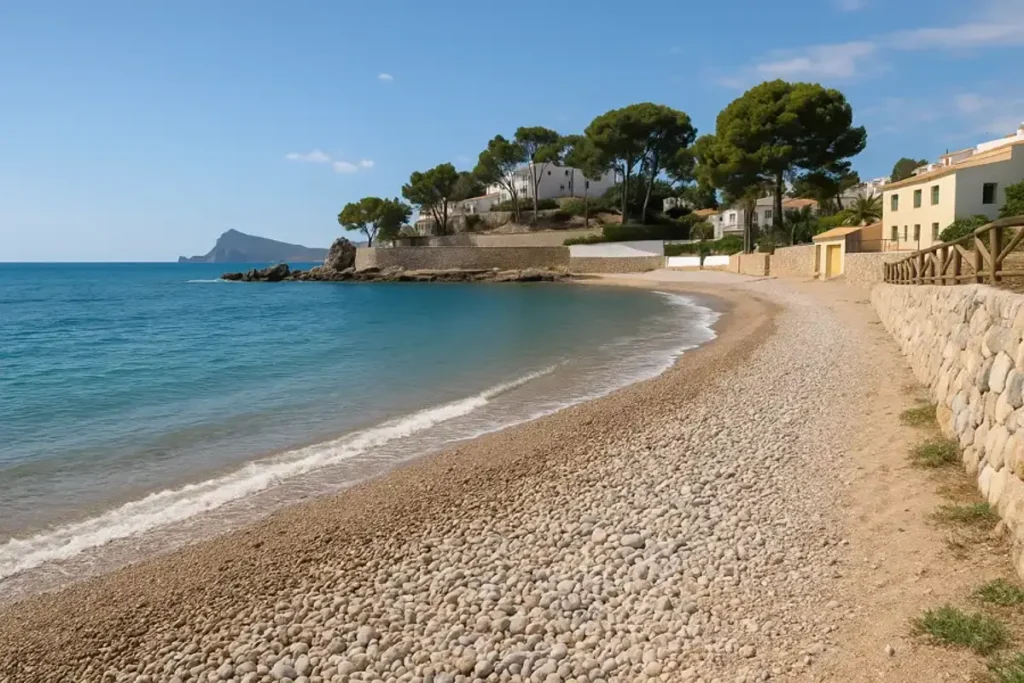

Cap Negret Beach is one of the most distinctive beaches in Altea. You won’t mistake it for the typical fine-sand beaches of the Costa Blanca, because here the gray and black rounded pebbles rule, the product of ancient volcanic material that still surfaces in the area. What some see as an inconvenience, others see as part of the charm: the sound of the waves rolling over the stones, the clarity of the water and a more peaceful atmosphere than at other urban beaches.
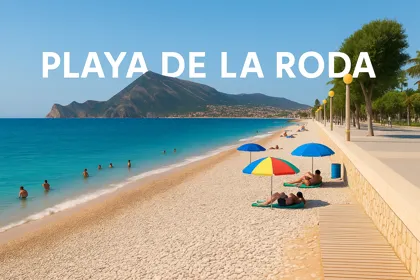
Located north of Altea’s town center, Cap Negret stretches along roughly 2 km of semi-urban coastline. Its name is associated with both the beach and the hotel that presides over it, a familiar landmark for visitors. Although it doesn’t have all the facilities of Blue Flag beaches (such as La Roda or Cap Blanc), it has its loyal following: couples, families who already know “the trick” of bringing water shoes, and visitors who value peace and quiet.
A curious fact: in 2020 the Generalitat Valenciana declared the area the Cap Negret Volcanic Outcrop and Fossil Beach Natural Monument. That means you don’t just enjoy a relaxing swim, but also a protected geological setting of great scientific and educational interest. Strolling along its shore and looking at the black stones is like walking through millions of years of natural history.
Cap Negret isn’t the beach for anyone looking for a beach bar at every turn or golden sand that’s gentle on the feet. But if your idea is to spend a few calm hours with plenty of room to spread out your towel, swim in clean water and enjoy open views of the Sierra de Bèrnia, this is a great candidate.
Table of Contents
ToggleFacilities, Atmosphere and Accessibility
Cap Negret Beach doesn’t have a seafront promenade as well defined as the one at La Roda, nor a row of bars right at the water’s edge. Here facilities are concentrated in high season, from June to September, and are more spread out. You’ll find showers and foot washes, as well as spots with sunbeds and umbrellas for rent, but not along the whole length of the beach. Temporary beach bars are also usually set up, bringing the beach to life in summer with soft music and simple cocktails.
What you will notice is that the atmosphere is more relaxed than at other urban beaches. Cap Negret is wide and never feels crowded, and even though it fills up in August, you can always find some space. It’s common to see couples looking for peace and quiet, families who already know the trick of water shoes, and locals who come first thing in the morning to swim in clean water. In the evening, the sun sets behind the Sierra de Bèrnia, creating very photogenic scenes.
As for accessibility, the beach has several entrances from the N-332 and the parallel service road. Parking isn’t a problem out of season, but in July and August it’s best to arrive early. Access for people with reduced mobility exists at a few specific points, although it isn’t as complete or comfortable as at Blue Flag beaches. In season, wooden walkways are usually put in place to make it easier to reach the water’s edge, but it’s always worth checking with Altea town hall or the tourist office before planning your visit.
The type of ground, made up of rounded pebbles and rock, is what makes Cap Negret special… but it’s also what can make it uncomfortable. That’s why, for adults and children alike, wearing water shoes is almost essential. Those who come prepared come back; those who arrive expecting golden sand are sometimes disappointed. That’s the secret behind it staying a peaceful beach on such a touristy coast.
How to Get to Cap Negret Beach
Getting to Cap Negret is easy, and it’s actually one of the best-connected beaches in Altea. It’s located north of the town center, right next to the national road N-332.
By car
If you’re coming by car, the usual route is to take the N-332 and exit around km 159, where a service road runs parallel to the beach. Right there you’ll find free parking spaces, although they’re scattered and fill up quickly in high season. If you want absolute convenience, the Hotel Cap Negret has its own car park (with free outdoor spaces and paid covered ones).
By TRAM (train)
One of the great attractions of this beach is that it has its own TRAM d’Alacant station. The Cap Negret stop is on Line 9 (Benidorm–Dénia) and drops you literally at the beach. It’s a very convenient option if you’re staying in Altea, Benidorm or any town connected by the line. Just check the timetables, because frequency varies and during periods of works (as happened in 2024 on viaducts and tunnels) part of the route was replaced by shuttle buses.
By bus
The bus doesn’t go right down to the shore, but it does reach the N-332 road at nearby points. From there it’s only a few minutes on foot. It’s useful if you travel on intercity lines or arrive from Benidorm on medium-distance connections.
On foot or by bike
If you’re staying in Altea’s town center, the walk is easy: about 15–20 minutes from La Roda Beach, following the coastline. By bike it’s even quicker and more comfortable.
In short:
Car: easy, but limited in the middle of August.
TRAM: the most scenic and practical option, with a station right at the beach.
On foot: recommended if you’re staying in central Altea.
This good connectivity means Cap Negret is visited by tourists and locals alike, but because it isn’t the typical seafront-promenade beach, it keeps a sense of calm that other, more central beaches don’t have.
Natural and Geological Setting
If anything makes Cap Negret Beach special, it’s that it isn’t just a place to swim but also a protected natural area of great geological value. In 2020 the Generalitat Valenciana declared the area the Cap Negret Volcanic Outcrop and Fossil Beach Natural Monument. This covers both the land strip and part of the sea, adding up to more than 10 hectares of protected area.
The name of the beach (“negret” means “little black one”) comes precisely from the black volcanic stones that define it. These rocks tell the story of eruptions millions of years ago, which left behind basaltic materials unique in the province of Alicante. As you walk along the shore you’ll notice that the pebbles are different from those on other Altea beaches: dark tones predominate here, mixed with gravel and embedded fossils.
Swimming at Cap Negret therefore has an almost educational side to it. It’s like swimming in an open-air natural museum. The educational value of this spot is recognized by universities and experts, who use it as an example of Valencian geological heritage. For visitors, the essential thing is to respect this environment:
Don’t pull out or alter stones or fossils.
Avoid building little “pools” by moving pebbles around.
Don’t anchor boats over posidonia meadows, an ecosystem vital for keeping the water clean.
Besides the rock formations, the seabed at Cap Negret combines pebbles, rock and patches of Posidonia oceanica, which makes it a good place for easy snorkeling. On calm days you can see shoals of small fish and starfish, always taking care not to disturb the habitat.
The landscape is also defined by its views: inland, the Sierra de Bèrnia rises up, and looking north you can make out the outline of the Altea coast as far as Mascarat. This visual openness reinforces the sense of space and calm that defines Cap Negret.
All in all, it’s a different kind of beach, one that combines swimming and geology in one place. Here nature isn’t just the backdrop: it’s the star.
What to Do at Cap Negret
Although Cap Negret isn’t a beach with big facilities, it offers several ways to enjoy it if you know what to look for. It’s more a place for small, peaceful plans than for mass activities, ideal for anyone who wants to rest without the crowds.
Relaxed Swimming in Clear Water
The water at Cap Negret is usually clean and clear, thanks to the presence of posidonia and the pebbly bottom that keeps sand from being stirred up. On calm days it’s perfect for swimming parallel to the shore or simply cooling off. Just note that getting in and out of the water takes a bit more care because of the stones, which is why water shoes matter.
Easy Snorkeling
The mixed seabed (pebbles, rock and seagrass meadows) makes for easy snorkeling. Don’t expect colorful reefs, but you do have a chance to see small fish, crabs, starfish and other creatures. The best approach is to head to the ends of the beach, where there are more submerged rocks. Snorkeling at Cap Negret works well for beginners or families with curious kids, as long as the sea is calm.
Kayak or Paddle Board
The length of the beach invites short outings by kayak or paddle board. Paddling north toward Cala del Soio is a lovely experience first thing in the morning, with soft light and the Sierra de Bèrnia in the background.
Walks and Photography
Cap Negret is very photogenic: the black stones in the foreground, the crystal-clear water and the silhouette of the mountains make for photos that are different from the usual golden-sand shots. At sunset, the low side light brings out the tones of the rock and turns the beach into a small natural stage.
Relaxing Without Rushing
What many people come here for is to switch off. Spread out your towel, listen to the waves against the pebbles and read a book away from the bustle of the promenade. Cap Negret is one of those beaches that doesn’t demand much of you: its appeal lies in its simplicity.
Where to Eat Near Cap Negret
Cap Negret isn’t one of those beaches with a promenade packed with bars and restaurants right at the edge of the sand. The atmosphere here is calmer, and the food options are a bit more spread out. Even so, there are good choices both right on the beach and a few minutes away on foot or by car.
Hotel Cap Negret
The Hotel Cap Negret itself has a restaurant and terrace that are also open to outside visitors. Its menu combines Mediterranean cuisine with international dishes, and in summer it often runs special menus or themed nights. The setting is pleasant: eating on the terrace facing the sea is a safe bet if you don’t want the hassle of searching around.
Seasonal Beach Bars
In the summer months, temporary beach bars are set up on the beach. They’re perfect for a cocktail, a soft drink or some tapas without going far. They don’t have the variety of a proper restaurant, but they cover the basics: cold beer, paella to order or simple sandwiches.
Toward Central Altea
If you want variety and atmosphere, your best bet is to head to the Altea seafront promenade, about a 15-minute walk from Cap Negret. There you’ll find everything from traditional tapas bars to international restaurants. It’s a good option if you spend the whole day at the beach and then want to finish with a proper dinner.
Practical Recommendation
For convenience: Hotel Cap Negret, everything in one place.
For a beachy vibe: a seasonal beach bar, feet in the gravel and a drink in hand.
For variety: Altea seafront promenade, with menus for every taste.
Cap Negret isn’t designed for eating on every corner, but that’s part of its identity. The dining experience here can be quieter and tied to the hotel, or it can become an excuse for a walk to the center of Altea, where the choice is far wider.
Places to Stay Near Cap Negret
If you plan to spend several days in Altea and want to be literally a couple of steps from the sea, Cap Negret Beach offers some interesting options, from the big hotel that gives the area its name to small places to stay scattered around.
Hotel Cap Negret
The undisputed star is the Hotel Cap Negret, a four-star hotel right on the seafront. It’s not just accommodation: it’s practically the heart of this beach. Its strengths are:
Direct access to the beach, something few hotels in Altea can boast.
A large outdoor pool, perfect if one day you don’t feel like dealing with the pebbles on the shore.
A huge cycling center, designed for sports tourism (road cyclists and triathletes often stay here).
Free outdoor parking and paid covered spaces (with electric car chargers).
Entertainment and events in high season, with live music and activities for adults.
This hotel is ideal for anyone who wants to forget about the car and get around on foot or by TRAM. Many guests choose it for the convenience of going from their room to the sea in barely a minute.
Other Nearby Places to Stay
Besides the big hotel, the Cap Negret area has tourist apartments and vacation homes that are rented by the week. Some are right on the seafront and others are set back a bit toward the road, but all have the advantage of being in a quieter setting than the town center.
If you’d like a wider choice of hotels, our recommendation is to look toward the center of Altea or toward Cap Blanc. There you’ll find everything from boutique hotels in restored houses to aparthotels with slightly more affordable prices.
Recommendation
For convenience and full services: Hotel Cap Negret.
For privacy: rental apartments or houses near the beach.
For more of a city vibe: hotels in the center of Altea, just 5 minutes away by car or TRAM.
Sleeping at Cap Negret means falling asleep to the sound of the waves. Just keep in mind that, as the area has limited capacity, it’s best to book ahead, especially in July and August.
Practical Tips and the Best Times to Visit Cap Negret
Visiting Cap Negret isn’t the same as going to a fine-sand beach in Benidorm or in Albir itself. The setting here is different, and a couple of tricks can make the difference between an uncomfortable day and a perfect one.
Water Shoes: Your Best Ally
The pebbly ground looks lovely, but it’s uncomfortable to walk on and to get into the water over. A pair of water shoes solves the problem: they protect against slips and cuts and let you enjoy your swim without thinking about every step. If you’re coming with children, they’re almost a must.
Umbrella and Thick Mat
Pebbles aren’t a thin towel’s best friend. If you’re not renting a sunbed, bring a thick mat or even a folding mattress. An umbrella is also a good idea: although the beach is wide, there’s little natural shade and the sun beats down in summer.
Choosing the Right Time
Early morning: calmer water, a quiet beach and good light for photos.
Late afternoon: a spectacular sunset with the Sierra de Bèrnia outlined on the horizon.
Midday in August: only recommended with an umbrella and plenty of water on hand.
Avoid Heavy Ground Swell
On days with heavy swell, getting into the water gets tricky. The stones roll with the current, which can be uncomfortable or even dangerous for small children. Before you go, check the weather forecast: if the sea is calm, the experience changes completely.
Respect the Environment
Remember that Cap Negret is a Natural Monument. Don’t move stones to make improvised little pools, don’t pull organisms off the seabed and, if you come by boat, avoid anchoring over posidonia. The beach’s charm depends on keeping it intact.
Plan B on Windy Days
If the sea isn’t cooperating, you can move to other Altea beaches that are better sheltered and have more facilities, such as La Roda or Cap Blanc. They’re only a few minutes away and offer finer sand and easier access.
In short: coming prepared is the key. With water shoes, a mat and a little planning, Cap Negret becomes a perfect spot for anyone looking for clean sea and peace and quiet.
Frequently Asked Questions About Cap Negret Beach
Does Cap Negret Beach have a Blue Flag?
No. In Altea, the Blue Flag flies at La Roda, Cap Blanc, El Bol and L’Espigó, but not at Cap Negret. That doesn’t mean it’s of lower quality, just that it has fewer certified facilities.
Is it sand or pebbles?
Cap Negret is made of rounded pebbles and dark gravel of volcanic origin. There is no fine sand. It’s part of its charm, but also a detail to keep in mind for your comfort.
Are there showers, sunbeds and beach bars?
Yes, although only seasonally (June to September). During those months you’ll find showers, foot washes, sunbed rental and a few temporary beach bars. Out of season, they aren’t always available.
Where can I park?
The beach has scattered spaces along the N-332 service road. In the height of summer they fill up quickly, so it’s best to arrive early. The Hotel Cap Negret has parking for guests and paid spaces.
Can I get there by public transport?
Yes. The TRAM d’Alacant (Line 9) has a stop called Cap Negret, right next to the beach. There are also intercity buses that stop on the N-332, a few minutes’ walk away.
Is it a good beach for kids?
Yes and no. The water is clear and usually calm, but the rounded pebbles can be uncomfortable for the little ones. With water shoes and a calm sea it’s perfectly suitable. On days with swell it’s not the best option.
Is it good for snorkeling?
Yes, especially at the ends of the beach. There are mixed seabeds of pebbles, rock and posidonia meadows where it’s easy to see small fish and marine life. Always with respect for the ecosystem.
Are dogs allowed?
Officially, no. Cap Negret is not designated as a dog beach. Altea’s municipal regulations prohibit it during the bathing season.
What is the best time of day to go?
Early morning (peace and quiet, calm water) and late afternoon (sunset with views of the Sierra de Bèrnia).
Conclusion
Cap Negret Beach is different from anything you’d usually expect on the Costa Blanca. Here you won’t find golden sand or a promenade full of bars, but you will find a protected natural setting, clean water and a tranquility that’s hard to come by in the heart of the Mediterranean. Its dark volcanic pebbles, the clarity of the water and the breadth of the beach give it a very special charm for anyone looking for something more authentic and less overcrowded.
That said, it’s a beach you enjoy best when prepared. A pair of water shoes, a thick mat and a bit of foresight with the weather (avoiding days of heavy ground swell) completely change the experience. If you come with those keys in hand, you’ll discover a perfect place to swim, relax and enjoy a unique panorama with the Sierra de Bèrnia as a backdrop.
Being well connected by road and by TRAM, it’s accessible both to tourists without a car and to locals who want to escape the bustle of La Roda. And if you ever want more atmosphere, a walk to the center of Altea gives you the full range of bars, restaurants and services.
All in all, Cap Negret is one of those beaches that divides opinion: some rule it out because of its stones, others choose it precisely for the same reason. The truth is that anyone who gives it a chance tends to come back, because it offers something in short supply in the area: space, calm and a character all its own.